
Go to documentation repository


Page History
...
- In the context menu of the Computer object select Create object => RTSP Server.
- Specify the name and ID of the object in the opened panel.
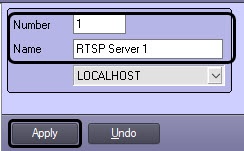
- Click the Apply button to create the object.
...
- Go to the RTSP Server object settings panel.
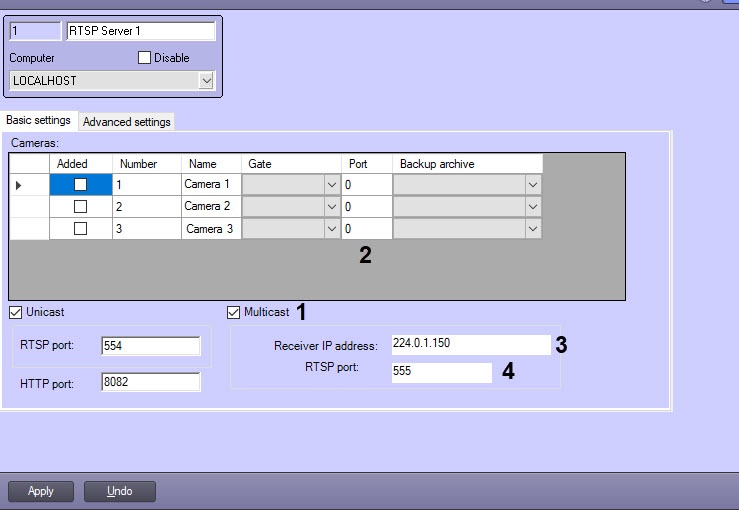
Set the Multicast checkbox (1). The Port column is displayed in the Cameras table.
Specify a data transmission port for each video camera in the Port field (2). Bear in mind the following when specifying ports:
- The following ports are in use for each camera in the Multicast mode: nPort, nPort + 18000 (rtp), nPort + 19000 (rtcp), where nPort – port number specified for camera in the Port column.
For proper operation of RTSP server in the Multicast mode these ports are to be vacant. - Specified ports are not addressed directly. Use RTSP port to get video from all cameras in the Multicast mode (see item 12).
In spite of specifying video data port it is required to specify camera number in the data source address (see the table below).
Info title Note. Use of the Multicast mode allows decreasing Server load due to reduction of transmitted data Info title Note. To get such video in Intellect (see Configuring multimedia receipt using RTSP protocol) set the multicast value to the RTSP parameter in the HKEY_LOCAL_MACHINE \SOFTWARE\ITV\Intellect\Video\TransportProtocols registry section (for 64-bit system the path is HKEY_LOCAL_MACHINE\SOFTWARE\Wow6432Node\ITV\Intellect\Video\TransportProtocols) on computer where the Camera object is created. Detailed information on this parameter see in Changing the transport protocol used by IP-device section.
Info title Note. RTSP Server can translate both in Multicast and Unicast modes simultaneously. Receiving both these streams on the Intellect client is impossible due to RTSP key defining the mode (see the note above). However, the VLC player allows receiving streams in both modes in the same time.
- The following ports are in use for each camera in the Multicast mode: nPort, nPort + 18000 (rtp), nPort + 19000 (rtcp), where nPort – port number specified for camera in the Port column.
In the Receiver IP address field (3) specify the address from which the broadcast in Multicast mode will be performed. Address is to be in range from 224.0.1.0 to 239.255.255.255. By default, the receiver IP is 224.0.1.150. Bear in mind the following when specifying Receiver IP address:
224.0.0.0-224.0.0.255 address range is reserved for routing protocols and other service protocols. Destination IP address cannot be set from the specified range.
RTSP-server can broadcast to one network simultaneously. The network with minimal metric is selected by default. To change the broadcast network, go to the Advanced settings tab (see below).
- Set different Receiver IP address and RTSP port if several RTSP Servers are in Multicast mode.
- In the RTSP port field (4) specify the number of port through which video signal will be sent in the Multicast mode. When requesting video data from the camera using the RTSP protocol, it is necessary to specify this port. The system itself forwards the request to the port of the requested camera.
...
- Go to the Advanced settings tab.
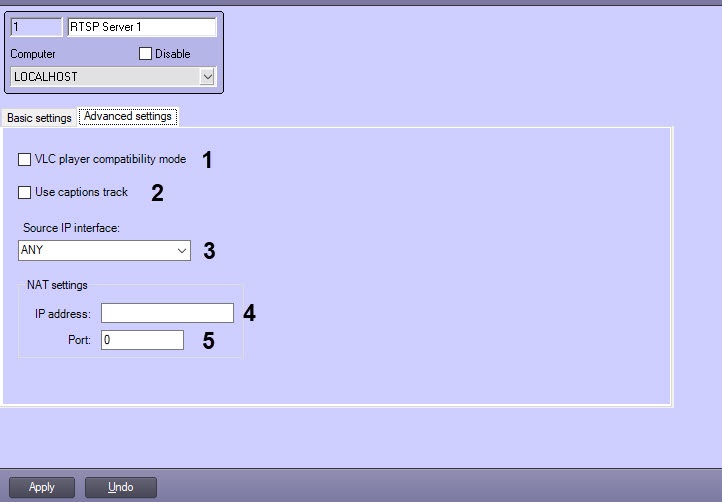
If the current time is to be sent to VLC Media Player instead of the frame time, then set the VLC player compatibility mode checkbox checked (1). This option is to be used in case of problems when playing back the archive received over RTSP in VLC Media Player.
If there are captions on the video (see Configuring captions display on a video image), set the Use captions track checkbox checked to send them along with video via RTSP Server and to display them in the receiving app – VLC player (2).
Also, when this checkbox is set, time captions are added to the video image in the format YYYYMMDDTHHMMSSZ. If the video is archive (see request examples below), then the captions show the archive time. However, if the VLC player compatibility mode is set along with the Use captions track check box, the time in the captions is current.Note title Important! Correct video and captions operation are enabled only in VLC Media Player 2.0.0. These features are not guaranteed to work in other versions of VLC Media Player or other programs.
From the Source IP interface drop-down list, select the name of the network interface that should be used to broadcast the RTSP server (3).
If the RTSP Server is used for broadcasting the video data to the Single Data Center (ECHD), and the Video Surveillance Servers are behind NAT, then it is necessary to specify the NAT settings:
In the IP addr field, specify the IP address of the router that performs the NAT broadcasting (4).
In the Port field, specify the port of the router, which is accessed by the client when executing the Single Data Center (ECHD) requests (5).
Info title Note To enable the substitution of the router's specified IP address and port to the Single Data Center (ECHD) requests, it is necessary to set the corresponding checkbox in the settings panel of the Web server object - see Enabling the processing of ECHD requests and selecting rtsp server.
Click the Apply button to save the changes.
...
- Go to the settings panel of the RTSP-Server object.
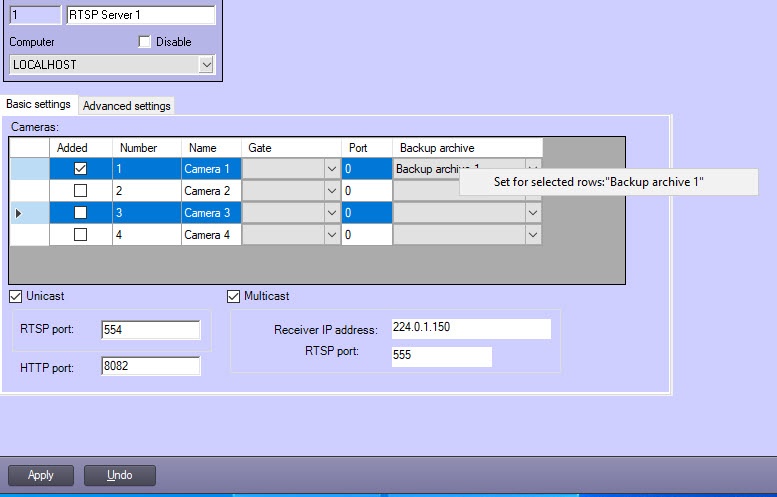
- Set the value of one or more reference parameters Added, Gate, Port, Backup Archive for one of the Camera objects.
- While holding down the Ctrl key, select the (full) rows in the table, which should have the same values in the corresponding columns.
- Right-click in the reference cell.
- In the opened function menu, select Set for selected rows: "Value". As a result, the corresponding column in all selected rows are filled the value equal to the reference parameter.
- Repeat steps 4-5 for all parameters that need to be applied to the selected lines.
...
Overview
Content Tools