
Go to documentation repository


Page History
| Section | |||||||||||||||||||||
|---|---|---|---|---|---|---|---|---|---|---|---|---|---|---|---|---|---|---|---|---|---|
|
...
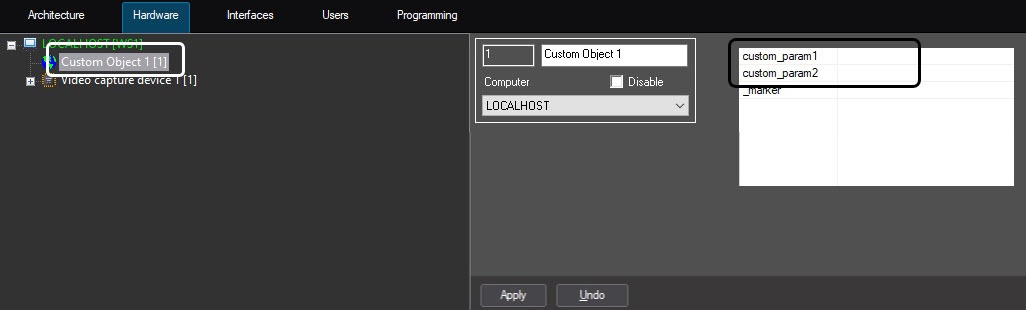
User parameters are displayed on the settings panel of the created virtual object – custom object – custom_param1 and custom_param2 in this example. Their values can be set in the table.
Showing on the map
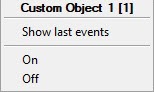
When an object is created in the hardware tree it can be placed on the map and set reactions can be executed in the object context menu (see Configuring the interactive map for object state indication and controlling the objects).
Using in macros
When a virtual custom object is created in the hardware tree it can be used in macros.
...
| Info | ||
|---|---|---|
| ||
| Reactions of virtual custom objects are automatically converted into events. Thus, in the sample when ON reaction is executed the object state changes thanks to set state transition rules (see ddi file preparation) and the icon corresponding to the state will be shown on the map. |
Sample program in Jscript to change
...
custom object state
Problem. Using macro 1 change a state of virtual custom object 1 to ON and show the icon corresponding to this state on the map.
Solution. As state transition rules are set, when ON event is sent from the virtual custom object the state will be automatically changed to ON and the icon specified in ddi file (see ddi file preparation) to this state will be shown on the map. A script for sending ON event looks like this:
...
Overview
Content Tools