
Go to documentation repository


Page History
| Tip |
|---|
Video stream and scene requirements for the Queue detectiondetector |
To configure the Queue detection tool, do the following:
- Go to the Detection Tools tab.
Below the required camera, click Create… → Category: Retail → Queue detection.
By default, the detection tool is enabled and set to count the number of people in a queue.
If necessary, you can change the settings of the detection tool parameters given in the table:
| Parameter | Value | Description |
|---|---|---|
| Object features | ||
| Record mask to archive | Yes | By default, the recording of the mask to the archive is disabled. To record |
...
| the sensitivity scale of the detection tool to the archive (see |
...
| Displaying information from a detection tool (mask)), select the Yes |
...
| value | ||
| No | ||
| Video stream | Main stream | If the camera supports multistreaming, select the stream for which detection is needed |
...
| Other | ||
| Enable | Yes | By default, the detection tool is enabled. To disable, select the No value |
| No | ||
| Name | Queue detection | Enter the detection tool name or leave the default name |
| Decoder mode | Auto | |
...
| Select a processing resource for decoding video |
...
| . When you select a GPU, a stand-alone graphics card takes priority (when decoding with |
...
| Nvidia NVDEC chips). If there is no appropriate GPU, the decoding will use the Intel Quick Sync Video technology. Otherwise, CPU resources will be used for decoding | ||
| CPU | ||
| GPU | ||
| HuaweiNPU | ||
| Number of frames processed per second | 1 | Specify the number of frames for the detection tool to process per second. The larger the value, the greater the load on the CPU. The value must be in the range [0. |
...
| 016; 100] | ||
| Type | Queue detection | Name of the detection tool type (non-editable field) |
| Advanced settings | ||
| Current queue size report interval | 0 | The default value is 0 (no events are sent). To send events to AxxonData (see Queue length report), specify the interval of events transmission in seconds. The value must be in the range [0, 600] |
| Frame size change | 1920 | The analyzed frames |
...
are scaled down to a specified resolution ( |
...
1920 pixels on the longer side) by default. |
...
The following algorithm is used:
|
...
|
...
|
...
|
...
|
...
|
...
|
...
|
...
|
...
|
...
| title | Note |
|---|
|
...
|
...
| Basic settings | |||||||
| Person size | 10 |
| |||||
...
Click the |
...
|

...
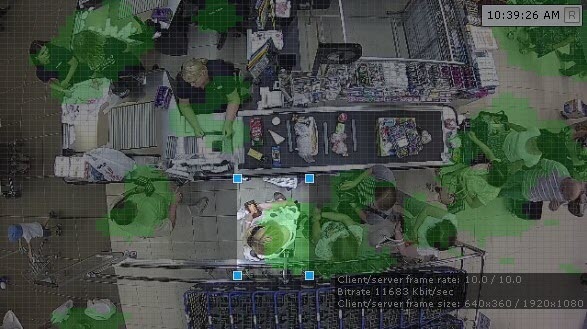
specify the minimum size of a |
...
person. To do this, move the anchor points of the rectangular area |
...
: |
| Info | ||
|---|---|---|
| ||
It is recommended to set the minimum size of a human graphically. The number in the Human size field is a conventional value. |
| |
| Queue size | 5 |
...
| Specify the number of |
...
| objects in |
...
| a queue |
...
| . When the number is exceeded, an event is generated. The value |
...
| must be in the range [2 |
...
| , 20] | ||
| Sensitivity | 0.5 | Specify the sensitivity of the detection tool |
...
| . The higher the sensitivity, the |
...
| better the algorithm |
...
| reacts to minor motion. If you specify the |
...
| minimum sensitivity value, |
...
| only significant scene changes |
...
| can be analyzed by the Queue detection. You |
...
| must specify the sensitivity value empirically based on the |
...
| data from the motion mask (see Displaying information from a detection tool (mask)) in the preview window |
...
In the preview window, you can
...
specify the detection
...
area by moving the anchor points
...
 (see Configuring a detection area).
| Info | ||
|---|---|---|
| ||
|


To save the parameters of the detection tool, click the Apply  button. To cancel the changes, click the Cancel
  button.
Configuration of the Queue detection is complete. The detection tool will generate events of the following type:
| Code Block |
|---|
...
The Queue detection tool is now configured. When the detection tool is triggered, the following events are generated:
| No Format |
|---|
Camera. Detection "Queue detection" triggered, queue (min.: 10, max.: 10) |
where min. and max. is estimated queue length.
Overview
Content Tools