
Go to documentation repository


Page History
To configure Record to archive, do the following:
Selecting Select a camera or a group of cameras for recording , the video from which you want to record to the archive (1). An implicit selection of a video camera is also allowed − —Camera that initiated command execution (see Configuring start conditions).

Note title Attention! If the start of the macro was triggered by the activation of an event fron an input or output (see see Configuring start conditions) that is not connected to any camera, you need to select a specific camera here. If you select a group of cameras or a camera that triggered initiated the command, the action will not doesn't start.
- Select an archive to write to (2).
Configuring Specify the conditions that end recording.
Condition
Description
Timer (3)
Only a timer value is set. Recording stops according to the time setting.
Event filter (5)
One or several events are set, the timer is set to 00:00:00. Recording stops on when any IF event .from the filter occurs
Timer (3) + Intelligent event Event filter (IF) (5)
One or several events are set, the timer is set to non-zero. Recording stops when the set time interval expires after any IF event (trigger) occurs.event from the filter occurs
Timer (3) + OR flag checkbox (4) + IF Event filter (5)
One or several events are set, the timer is set to non-zero, the OR flag checkbox is set. In this case, the recording stops on when any of the two conditions occurs first: after the time interval expires or if an IF event (trigger) occurs. when any event from the filter occurs
Info title Note title NoteThe OR flag - You can
- set the OR checkbox only if the timer setting is not 00:00:00.
Info An implicit selection of an event is allowed
—Last event for condition that initiated execution (see Configuring start conditions).
For example, if the event that
initiated the execution of the command was
the Start time of detection tool trigger from any type of detection tools, then the end event will be the End time of detection tool trigger from the same tool.
Set the pre-alarm recording prerecord time (6). The maximum pre-alarm recording prerecord time is 30 seconds.
Note title Attention! - By default, the
- prerecord time interval is set to the value specified in
- the archive settings (see Configuring recording to an archive).
- The
- duration of the prerecord time corresponds to the longest value among the set values.
- Changing this value of the prerecord time in a specific macro does not affect the
- archive settings.
If you have cameras in continuous recording mode (see Configuring recording to an archive) and you want to record with specified fps a specific FPS (see example 2), to change the frame rate, enter the required frame rate (7). After the macro command completes, recording resumes at the frame rate specified in the archive settings.
You can use special codesvalues:0 − —do not change the current frame rate (default).
-1−1—record only I-key frames.
1000 − —record at the standard fps FPS of the camera.
Note title Attention! Fps for pre-recording will not - FPS for prerecord doesn't change.
- If the macro
- is set to complete some time after a specified event
- is received (see
- step 3), the frame rate
- changes for this
- time.
Note title Attention! - When decimating all video streams except MJPEG, only
- keyframes are saved, so
- we recommend using special values for them -1 and 1000.
- If you
- specify a custom frame rate
- , decimation is performed by key frames.
- In MJPEG video stream all frames are key frames, so it makes sense to set
- an explicit frame rate
- value for it.
Example 1. A macro -command to initiate VMD-triggered recording to the Archive the archive when the Motion detection generates an event from any camera within the Default Axxon-domain (see Configuring start conditions).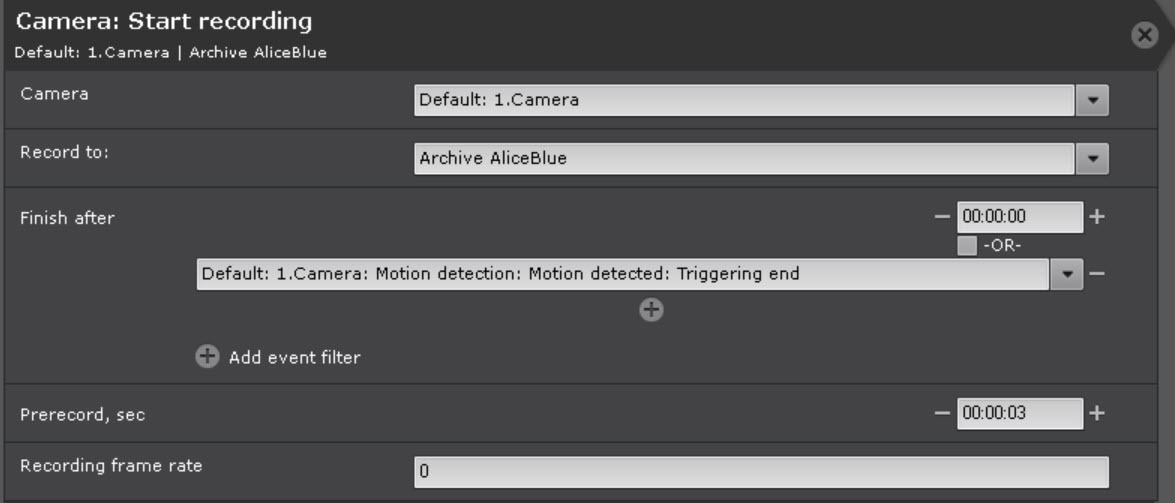
Example 2. All video cameras from the the Default Axxon Domain -domain are set to continuously record video at the specified fps by dropping frames (see with decimation to the archive (see Configuring recording to an archive). When you have a motion detection event, you need to switch to full fps recording. Configure the following macro to do soTo record events from the Motion detection at full FPS, the following macro must be configured:
Overview
Content Tools