
Go to documentation repository


Page History
| Section | |||||||||||||||||||||
|---|---|---|---|---|---|---|---|---|---|---|---|---|---|---|---|---|---|---|---|---|---|
|
General information and recommendations
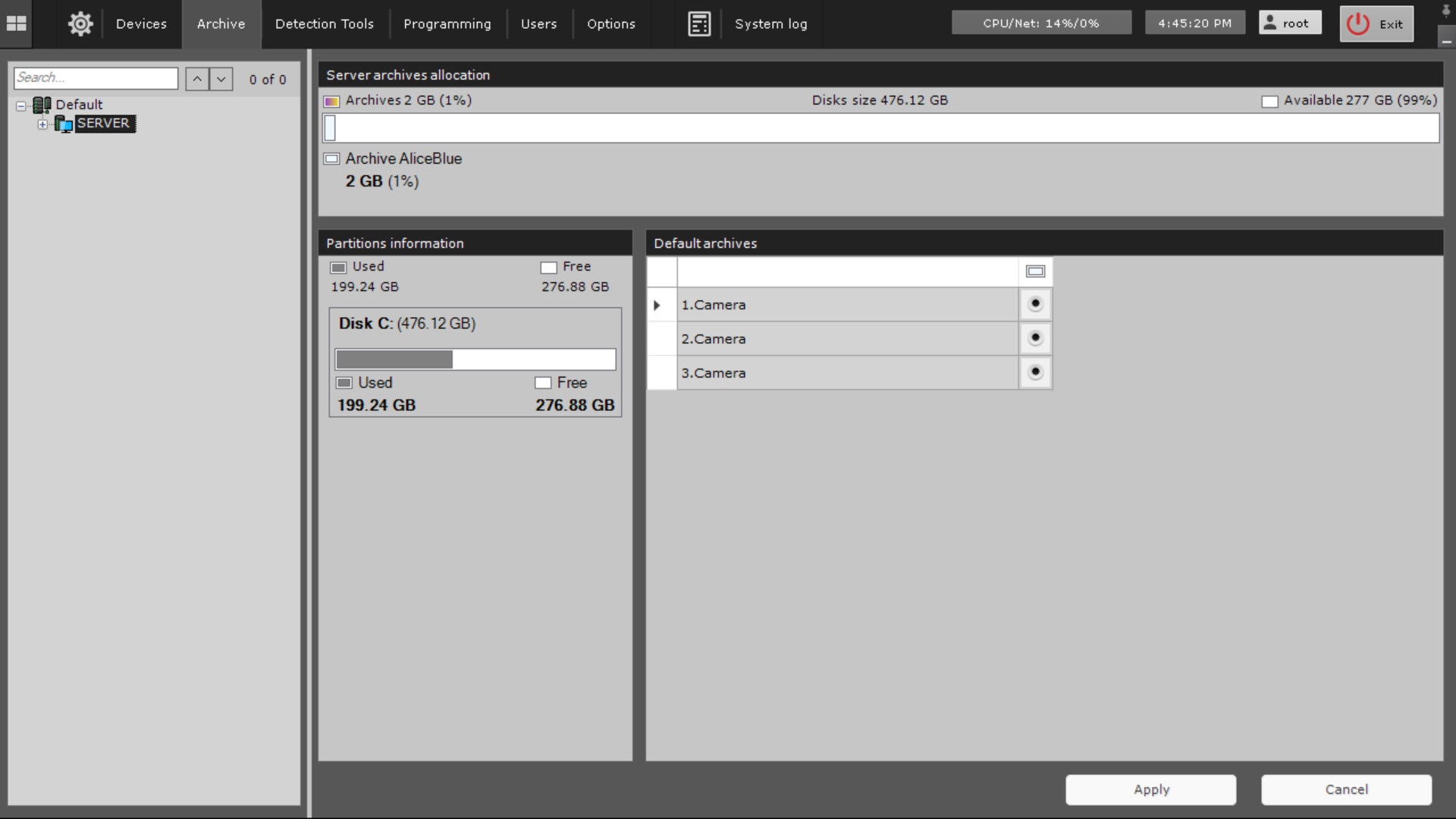
You can configure archives using on the interface of the Archive tab. To create archives, you must have the appropriate permissions (see Roles). You can create an unlimited number of archives on the basis of one Server.
The archive can be stored:
- on local disks (see Creating a local archive);
- on remote disks (see Creating a remote archive);
- in cloud storages (see General information about the cloud archive).
| Note | ||
|---|---|---|
| ||
|
Features of archives:
Types of archives and their features
| Type of archive | Features of archive storage | Restrictions on archive volumes | Configuration features |
|---|---|---|---|
| Local | Archive can be stored |
Local archive
Remote archive
| on several logical disks of the Server |
| On one logical disk for one archive, you can create only one archive volume, which occupies either a file of a set size or the entire partition (logical disk) |
| ||
| Remote | Archive can be stored in several remote storages | Archive can be stored only as a file of a specified size |
| Archive can either have a block or object storage type | ||
| Cloud | Archive can be stored in one cloud storage | Archive |
| can contain several volumes of unlimited size. You can change the size of the archive without restarting ngp |
Data from a local, remote, or cloud archive can be copied to other local, remote, or cloud archives (see Configuring data replication).
You can create an archive based on the following solutios (see General information about the cloud archive):
|
General algorithm for configuring an archive
To configure an archive, do the followingYou can configure the archive as follows:
- Create an archive (see Creating archives).
- Configure recording of camera streams from video cameras
- to archive (see Configuring recording to an archive).
Configure data replication, if necessary (see Configuring data replication). Data from a local, remote, or cloud archive can be copied to other local, remote, or cloud archives.
You can also connect external archives—a set of video recordings with time links.
...
Requirements for disk space arrangement
- When you create an archive, note that disk must not be full completely. For the correct operation of the system, it is necessary to leave some space free. General recommendations for arranging free space:
- If archive size is less than 1 TB, you need about 100 MB of free space.
- If archive size is between 1 TB and 10 TB, you need about 1 GB of free space.
- If archive size is larger than 10 TB, you need about 10 GB of free space.
- For archives with object storage type, we do not recommend using an archive as a single volume of large size. You must split the archive into several volumes and place them on different physical devices. If placing several archives on one physical disk is unavoidable, free space must be N times larger (N is the number of archives).
- We recommend creating archive volumes of no more than 30 TB each.
...
Overview
Content Tools