
Go to documentation repository


Page History
| Section | |||||||||||||||||||||
|---|---|---|---|---|---|---|---|---|---|---|---|---|---|---|---|---|---|---|---|---|---|
|
Configuration of of Axxon PSIM system objects generally includes the following stages:
...
- Open the Hardware tab containing the objects tree.


- Select an object in the objects tree by clicking it with the mouse.


Create an object
...
- Open the Hardware tab containing the objects tree.
- Select a parent object in the objects tree, which should be used as a basis for the creation of a child object.
- Display the context menu by clicking the right mouse button and select Create object.


- Select the type of a new object using the corresponding second level menu.


As a result of the above operations, the object settings panel will display an identification panel for the new object.
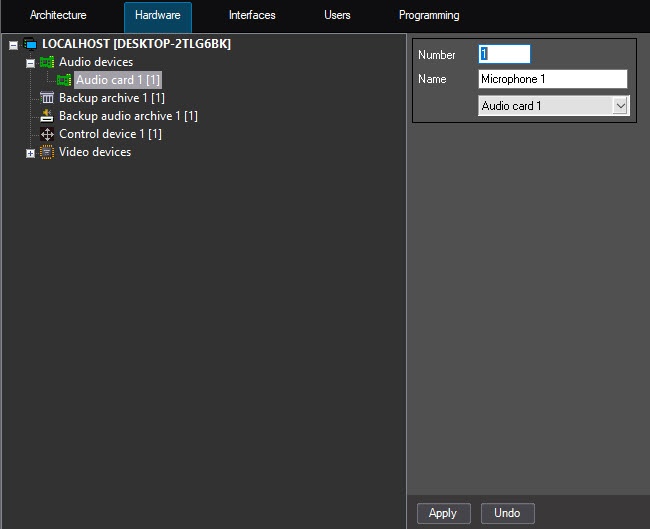
Specify a unique identification number in the Number field (1) and the unique name of a new object (the Microphone object in the example on the figures) in the Name field (2).


Info title Note For the list of restrictions on the use of characters for object identifiers (Numbers), see Identifiers (numbers) of system objects.
You should not use the > and < characters in the Name filed. If these characters are used in the object name, they will be removed when settings are applied.
If the identifier or the name already exist in the system, the corresponding message is displayed on the panel, and the field is highlighted in red.


- Click the Apply button to complete the object creation process.

As a result, a new child object will be created based on the selected parent system object.


Info title Note If the parent system object has one or more child objects, then you can expand the list of child objects using the
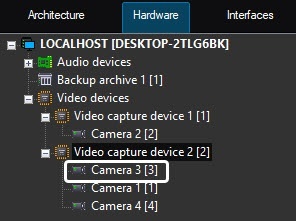 icon, and collapse the list using the
  icon.
icon.
...
- In the objects tree, select a system object the parameters of which should be edited by clicking the object (1).
Edit the object parameters using the settings panel of the object (2).
Info title Note The object ID cannot be edited.
The object name can be changed, however, if an object with the same name already exists, the corresponding message is displayed when applying the settings:


- Click the Apply button to save the changes (3).

Change the parent object
...
- Select the system object the position of which should be changed in the objects tree.


Select a new parent object in the drop-down list on the settings panel of the object. The name of the drop-down list is the same as the type of the parent object.

Info title Note If the object is moved to another computer, Axxon PSIM should be restarted on both computers—on the one the object is moved to and on another the object is moved from. As a result, the object is displayed in the objects tree of the selected parent object.

...
- Select an object in the objects tree (1).


- On the settings panel, set the Disable checkbox (2) and click the Apply button (3).


- As a result, the
 symbol will appear next to the disabled object (4).

To enable an object, set the Disable checkbox clear in the settings panel and click the Apply button.
...
- Select an object or a folder that should be deleted (1) and right-click to display the context menu (2).

Select the Delete object item in the menu.

Info title Note You can also select the object that should be deleted and press Ctrl+Del instead of using the context menu.
As a result, a dialog box requesting confirmation of the object deletion will appear on the monitor.
Click the OK button.


The figure below displays the result of an object deletion (objects tree contents after the object was deleted). The deleted object (the Microphone object in the example) is no longer displayed in the objects tree.


| Info | ||
|---|---|---|
| ||
The object settings are applied after switching to another fragment, regardless of clicking the Apply button. |
...
Overview
Content Tools