
Go to documentation repository


Page History
...
| Section | |||||||||||||||||||||
|---|---|---|---|---|---|---|---|---|---|---|---|---|---|---|---|---|---|---|---|---|---|
|
...
Information about Incident manager events is displayed in the events event table located in the upper part of the window interface:

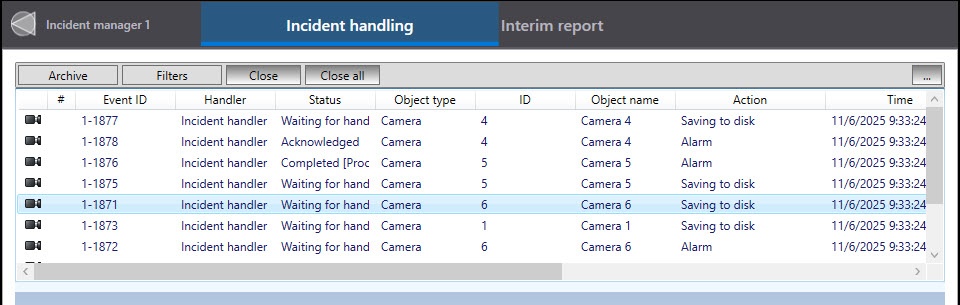
You can group, filter, and sort the events. The list displays the event status, and you can take handle the event into processing from there here (see see Events processing).
When you open the Incident manager window, the events Monitoring mode event monitoring opens by default, which displays only the current events that require processinghandling. To view all events of the Incident incident manager, go to the Archive.
Viewing current events
...
- Indicator of the presence of the camera associated with the event
 .
. - #—the column displays the indicator of event locking.
Display of locking:- Locked remotely—
 .
. - Locked locally—
 .
.
- Locked remotely—
- Event ID.
- Handler—the Incident handler—the name of the Incident incident handler that processes handles the event.
- Event status.
- Object type.
- Object ID.
- Object name.
- Action—description of the event.
- Time the event occurs.
- Priority.
- Computer—the name of the computer from which the event is received.
- Time (secs)—the number of seconds since the event occursoccurred.
- Last comment—only the last comment entered while processing handling the event.
- All comments—all comments entered while processing handling the event.
- Additional information.

To change the displayed information columns, do the following:
- Click the
 button (1).
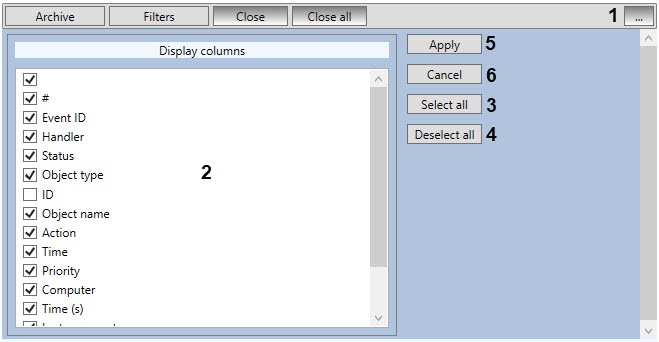
- Set the checkboxes next to the columns that you want to display (2). To set checkboxes next to all columns, click the Select all button (3); to clear the checkboxes, click the Deselect all button (4).
- Click the Apply button (5). To cancel the changes, click the Cancel button (6).
Event statuses
By default, the event with the an event is sent to the incident manager with the Waiting for handling status gets to the incident manager. Subsequently, . Later the event can receive the following statuses, depending on the operator's actions (see see Events processing):
- Acknowledged. This status is displayed if an event is taken into processing and is currently being processedhandled.
- Suspended. This status is displayed if event processing is started and not completed but handling was started, wasn't completed, and was suspended.
- Taken by others/<Last name of the operator who took handled the event into processing>event>. This status is displayed if the event is being processed handled by another operator.
- Suspended by others. This status is displayed if event processing is started and not completed but handling was started, wasn't completed, and was suspended by another operator.
- Escalated. This status is displayed if the event is escalated to another operator.
The following options are available:- Escalated/Suspended by others—status immediately after escalation.
Escalated/Taken by others—the escalated event is taken into processing handled by another operator.
Info title Note Depending on the incident manager settings, when an event is escalated, it can not change its status but disappear from the list for those who escalated the event.
- Escalated/<Last name of the operator who escalated the event>. This status is displayed to the operator to whom the event is escalated.
- Escalated/Acknowledged. This status is displayed to the operator to whom the event is escalated when they take handle it into processing.
Grouping events in the list
If the event grouping in the list is enabled in the settings (see Configuring events grouping in Incident manager), the events in the list are grouped by object type/object ID/event type/logic ID.

To view the events within the group, click the
 button.
Depending on the settings, when you expand a group, either the first event or all events of the group are displayed.
...
To sort events alphabetically, click on the name of the required column upon , the values of which you want to sort.
...
- Click the Filters button (1).
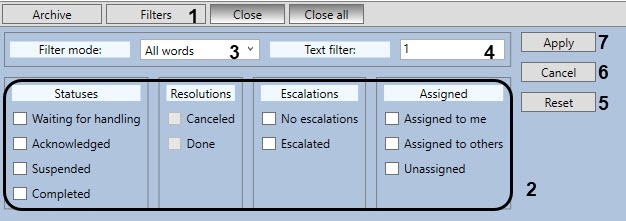
- Apply the filter in one of the following ways:
Set the checkboxes next to those values in the columns by which you want to apply the filter (2). As a result, only those objects that match all the filter criteria at the same time are displayed. To clear all selected checkboxes, click the Reset button (5).
Info title Note If you want to display the events assigned to the current operator or to other operators, you must set the checkbox next to the Assigned to me or Assigned to others value in the Assigned column, respectively. If you want to display the events assigned to both the current operator and other operators, set the checkboxes next to both the Assigned to me and Assigned to others values.
- From the Filter mode drop-down list (3), select the search criterion:
- All words.
- Any of words.
- Substring.
- In the Text filter field, enter the object name, object ID, or the action of the event (for example, Activated) by which you want to apply the filter (4). You must not don't have to enter the full object name, object ID, or action. The filter displays all found matches based on the value entered in the the Text filter field. To delete the entered value, click the Cancel button (6).
- Apply the filter to both the checkboxes and text at the same time. To do this, enter the object name, object ID, or action (4) in the Text filter field, and set the checkboxes next to the column values by which you want to apply the filter (2). As a result, events that match both the entered text and the selected checkboxes are filtered out. To clear all selected checkboxes and delete the entered value in the field, click the Cancel button (6).
- Click the Apply button (7).
As a result, objects and events that match all selected filter criteria are displayed at a time. For example, if you set the checkboxes next to the Acknowledged and Assigned to me statuses, then all work in process events that are assigned to the current user are displayed.
| Info | ||
|---|---|---|
| ||
If you set all the checkboxes in the Statuses column, it means the same as if none of them is set. The same applies to the Assigned column. |
Example of applying the event filter by the object ID:

| Info | ||
|---|---|---|
| ||
You can also configure the filter using the SETUP_FILTER reaction in the IIDK interface (see INC_MANAGER Incident manager). |
| Anchor | ||||
|---|---|---|---|---|
|
...
Event archive
To go to the events event archive, click the 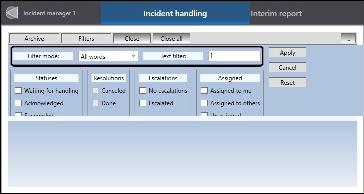
 button on the top panel. As a result, the list of archived events opens:

In the event archive, you can do the same actions as in the event monitoring mode: apply filters, use the Close and Close all buttons, generate an interim report, and select columns to display them in the table. Besides that, on the top panel you can set the parameters for displaying the archive display:

where:
- the The period for displaying the archived events is specified by the date and time of its beginning (1) and end (2);.
- the The Refresh button is used to update the events event list if the display period is changed (3);.
- item Item 6 is the number of the displayed page;.
- item Item 7 is the total number of pages;.
- buttons The buttons < and > are used to go to the previous/next page (5 and 8);.
- buttons The buttons << and >> are used to go to the first/last page (4 and 9).
To return to the current events, click the  button.
Overview
Content Tools