
Go to documentation repository


Page History
You can use the AxxonOne NGP manager hardware object to set up integration with Axxon One. You can create only one AxxonOne NGP manager object per one Axxon PSIM server, so if you need integration with multiple several Axxon One domains, you must use multiple several Axxon PSIM servers.
| Section | ||||||||||||||||||||
|---|---|---|---|---|---|---|---|---|---|---|---|---|---|---|---|---|---|---|---|---|
|
...
Create the NGP manager object
- Go to the Hardware tab in the system settings.
- Right-click the Computer object, and in the context menu that opens, select Create object → AxxonOne NGP manager.
Info title Note The Computer object must correspond to the Axxon PSIM server that is selected for integration.
- The Number and Name fields are filled in automatically, but you can edit them if needednumber and name are entered into the fields automatically. If necessary, you can change them.
- Click the Apply button.
- On the WEB-server Axxon One tab on the settings panel of the AxxonOne manager object, set the Enable checkbox.
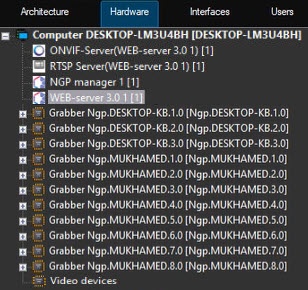
As a result, three objects are created: AxxonOne manager, along with ONVIF Server and RTSP Server associated with it.
The ONVIF Server (AxxonOne managerAs a result, the NGP manager object is created. For the correct operation, you also need to create the Web server 3.0 object. The ONVIF Server (Web server 3.0) and RTSP Server (AxxonOne manager) objects are Web server 3.0) objects associated with the Web server 3.0 object are automatically created in the hardware tree. These objects are used to set up integration using the Axxon One Web Server and are created by default. There is no web server. You don't need to delete or configure them; they must remain as they are.
...
Configure the NGP manager object
- Select the created AxxonOne manager NGP manager object in the hardware tree.
Go to the Integration with Axxon One tab, and set the Enable checkbox.
- Enter the information of the Axxon One instance you are connecting to:If you use a cloud connection for authorization in Axxon One, set the Cloud checkbox.
Field Description Default value Address IP address 127.0.0.1 Port Port for communication with the client (NativeBL port) 20109 Base port Port for operations within a domain 20111 Web port Web Server server port (HTTP port for failover server) 80 Login Axxon One username root Password Axxon One password root Info title Note The connection ports depend on the type of Axxon One installation (failover or not) and its settings. For more information, see the Axxon One documentation:
- Click the Update button to Refresh button to synchronize with Axxon One. This button initiates reading and updating the of the Axxon One configuration to retrieve information and send it to Axxon PSIM:
Note title Attention! Specifics of synchronization with Axxon One using the Update button Refresh button:
- After you click the button, you must wait for the process to complete without taking any further actions. This ensures that the states of Axxon One objects are correctly transferred.
- If the configuration of a running Axxon One server was previously retrieved and during the next synchronization the server status is "off," the hardware state in Axxon PSIM remains unchanged. This is done to prevent accidental configuration clearing, for example, if the Axxon One server is rebooting during synchronization.
- If you enter data of a new Axxon One domain for synchronization, the data of the previously synchronized domain will be are deleted. If synchronization is done with a server from the same domain, the data will remain.
- The hardware list, which was already retrieved, will be is synchronized between Axxon PSIM and Axxon One " on the fly. " However, to obtain information about new hardware or changes in the Axxon One configuration, you must click the Update Refresh button again.
- If you delete in Axxon PSIM devices delete devices and macros received from Axxon One (and they remain in Axxon One) in Axxon PSIM, they are recreated in Axxon PSIM during the next synchronization.
- Hardware objects retrieved from Axxon One are created in Axxon PSIM without configuration settings panels, as they can only be configured in Axxon One.
- Macros are created without predefined conditions, but you can configure them if needed. For more information, see Working with macros and events received from Axxon One.
The result of the synchronization is displayed in the information fields Last successful synchronization and Last synchronization state. If the synchronization was is successful, the hardware received from Axxon One appears in the hardware list, and the received macros appear in the Macros list on the Programming tab.:

- If you connect to the Axxon One failover server, set the Failover server checkbox and select the server, the cameras from which will be displayed in the Axxon One Monitor interface, from the drop-down list on the right, the server whose cameras are displayed in the NGP monitor window. If you connect to a regular server, not the the Axxon One failover server, you can skip this step.
In the Path field, specify the path to the previously installed Axxon One client AxxonOne.exe (see see Preconfiguration of Axxon One) that will be used to launch the Axxon One Monitor the NGP monitor interface object. The default path is: C:\Program Files\AxxonSoft\AxxonOne\bin\AxxonOne.exeIf the path is known, it is set automatically. Otherwise, the field remains empty, and you must enter the path to the file manually.
Note title Attention! Note that this path must be the same on all computers where you want to run the Axxon One client ( AxxonOne.exe). This means that the Axxon One client must be pre-installed in the same folder on all computers.
- Click the Apply button.
Integration with Axxon One is complete.
...
Delete the Axxon One configuration
To completely delete the integration with Axxon One configured as described above, do the following:
- Make sure that the last synchronization with Axxon One was successful (check the Last successful synchronization and Last synchronization state fields). If necessary, click Update to click Refresh to synchronize.
- On the settings panel of AxxonOne NGP manager, click the Delete configuration button.
- A The Delete configuration window opens. Click OK to confirm.
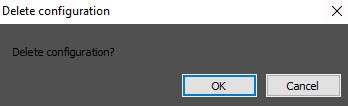
As a result, all hardware and macro lists associated with this integration will be deleted. If you configured an Axxon One Monitor the NGP monitor interface object, its camera list will also be cleared accordingly.
Overview
Content Tools