
Go to documentation repository


Page History
To start creating create a report, click the System failures 
 button.
A modal In the settings window opens. In this window, you can set the parameters needed to create the report.that opens:
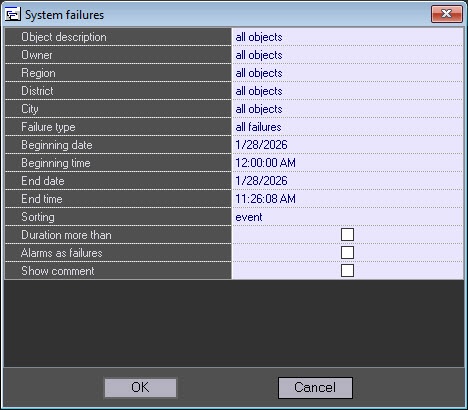
You can set the following report parameters:
- Object description. You can use this field to choose between two report modesFrom the Object description drop-down list, select one of three modes of creating a report:
- Report on all the system objects.
- Report on one system object.
- Report on several system objects.

- Select the required values from the Owner drop-down list. This information is set on the control settings panel (for more details, see the Editing regulatory and reference information page), as well as depends on the configured filter by owners in the Monitoring reports interface object (for more details, see Configuration of the Monitoring reports object). If you select a specific object (see step 1), then this parameter is hidden in the settings window.
- From the Region, District andCity in which
- , and City drop-down lists, select those regions, districts, and cities where the objects are located
- placed. This
- This information is configured
- set on the Control panel − see
- control settings panel (for more details, see the Editing regulatory and reference information . If
- page). If you select a specific object is selected
- (see step 1), then these fields are
- this parameter is hidden in the report
- settings window.
- From the Failure type . You can use this field to specify the failure type for which to create the report
- drop-down list, select the options by which a report is created. You can also create a report on all the
- failures within a certain time
- that occurred within the set period.

- Set the values of the Beginning date,
- Beginning time, End date, Beginning time, and End time. This setting is used for specifying
- and End time fields to specify the time range of the alarms
- failure occurrences by which the report will be generated
- a report is created. Sorting. You can use two sorting modes when creating a report:
- From the Sorting drop-down list, select one of two modes:
- event—sorting
Sort - by failures (cameras,
archive, etc.- archives, and so on).
Sort - time—sorting by the event
start - beginning time.

- beginning time.
- Set the Duration more than checkbox so that a report displays only failures with the duration more than the set value. By default, the checkbox is cleared, that is, all failures within the set time interval get to report.
- If you set the Duration more than checkbox, the following fields are displayed:
- Format—from the drop-down list, select the units to measure the failure duration: Days, Hours, Minutes, Seconds.
- Value—enter the failure duration.

- If you want to create a report on alarms in the same way as on failures, that is, to specify the beginning of the alarm, its end, and its duration, then set the Alarms as failures checkbox (for more details, see Alarms as system failures).
- Set the Show comment. Set this check box if it is necessary checkbox to display failure comments reports in the report comment (see Processing alarms).After you configure all the parameters, click the button .
You can see the report in a separate window.
- Click the OK button.
As a result, a report about system failures is created.
Example of a report on all failures (the Duration more than checkbox isn't set):
Example of a report on failures with the duration greater than the Duration more than 10 minutes set value:

The new Duration field appears in the common data at the top of the page.
Creating a report about system failures is complete.
Overview
Content Tools