
Go to documentation repository


Page History
...
Replication of archives the archive data refers to constant, block-by-block the copying of fixed-size blocks of information (video, audio, metadata) from one archive to another archive within the same domain. The primary purpose of data replication is to ensure long-term storage and access to multimedia recordings data on remote storage devices.
...
| title | Attention! |
|---|
Every archive can be
...
both the sender and
...
receiver of data.
| Note | ||
|---|---|---|
| ||
Replication occurs as information blocks are accumulated. 1 block may contain more than a minute of video. | ||
| Note | ||
| ||
Replication is performed
| ||
| Info | ||
| ||
Events
|
To configure data replication, do the following:
- In the list of archives on
- of the domain, select the archive to which you want to copy data from other archives.
Select one or more archives
form from which you want to copy data
(1). You can also replicate video from
on-board the embedded camera storage (
4, see
The - object
).
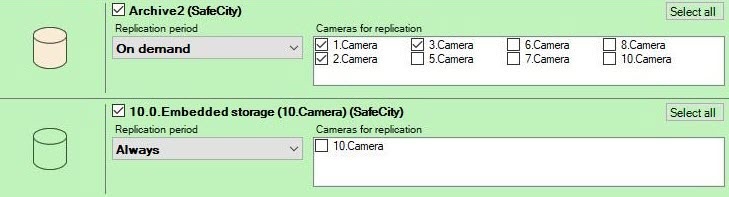
In the Replication period parameter, select the replication period:
Always—replication is performed continuously.
- Time schedule—replication is performed within the specified time schedule (see Creating schedules). For example, to distribute the CPU load, you can configure replication to run at night.
On demand—replication is started manually or using macros (see Manual archive replication, Start replication).
Note title Attention! - If you change the replication period in an existing replication archive, the archive recordings for the previous period are deleted.
- If you use an object archive, it is possible to record data and replicate it to the same archive at a time if you select the On demand replication period. For example, in the case of continuous recording and a short-term (for example, five minutes) loss of connection with the camera, you can use a macro to replicate the data from the embedded storage to the same archive to which the continuous recording is made.
In the Cameras for replication parameter, for each archive, select
the cameras from which data
will be are copied to the
source replication archive
(2).
To To select all cameras, click the Select
Allall button.
Info title Note - Data
for - from a particular camera can be copied to the replication archive only from one archive. When you select a camera for replication from an archive, the camera becomes unavailable for replication from any other archive.
- You cannot select cameras if they are already recording to the replication archive
.Always – replication will be performed continuously.
- Time zone – replication will be performed within the specified time schedule (see Creating schedules). For example, to distribute the CPU load, you can configure replication to run at night. On demand – replication will be started manually or using macros (see Manual Archive Replication, Start replication)
- .
- Click the Apply
 button.
| title | Note |
|---|
Select the replication process period (3):
Data Configuring data replication configuration is complete. If the replication period was is set to Always, data replication starts immediately after the settings are applied.
Data replication from the block archive to the object archive
If Axxon One performs continuous recording of streams from cameras to the block archive and you want to transfer data from the block archive to the object archive, you must:
- Create a new object archive.
- Replicate previously recorded data from the block archive to the object archive.
- Disable replication and bind cameras to the object archive for subsequent recording.
- Unbind cameras from the block archive, leaving only the object archive active.
As a result, all old recordings transferred from the block archive to the object archive are saved. New camera recordings are saved directly to the object archive.
Overview
Content Tools