
Go to documentation repository


Page History
...
| Section | ||||||||||||||||||||
|---|---|---|---|---|---|---|---|---|---|---|---|---|---|---|---|---|---|---|---|---|
|
...
Event handling
To start processing handle an event, do the following:
- Right-click on an the event in the table.

- Select Acknowledge.
After that, The event gets the Acknowledged status, and the first element will be is displayed in the event handling interface. After processing you handle each element, the next element will be is displayed. The last element will is always be the button.
There are 6 seven different types of elements available:
- Button.
To continue processing the event handling, click the button. If this element is the last in the logic , then after clicking the button, the event processing will be completed. - Radio button. To continue processing the event, select one of the values.
- and you want to close the event handling interface after you click the button, select the Yes value in the Finish parameter during the setup of this button. For more details, see Configuring the button.

- Date/time.
In the Incident manager window, the operator can specify the date and/or time of the handled event. For more details, see Configuring the date/time.
Configuration methods:- Date setting:
- Enter the date manually.
- Select the date via the standard calendar window.
- Time setting:
- Enter the time manually.
- Adjust the time with the up and down buttons.
- Date setting:
- Radio button.
To continue the event handling, select the required position. For more details, see Configuring the radio button.
- List.
To continue the event handlingList. To continue processing the event, select the required value from the list. There can be several lists.For more details, see Configuring the combobox.

- Checkboxes.
To continue processing the event handling, set one or more checkboxes. For more details, see Configuring the checkbox.
Comment.
To continue processing the event handling, enter a comment and click the Send button. The name of the button is set by the user.
Info title Note Depending on the Incident incident manager settings, the comment can be filled in automatically and blocked protected from editing. For more details, see Configuring the comment.
Image.
To continue processing the event handling, add an image and click the button. The text on the button depends on the Administrator settingsadministrator settings (see Configuring the image). In the example below, it is the Next button.
The following options for of working with an element are available:The element already displays the image specified by the settings, or the image from the camera or the map associated with the event. The event can be associated with several cameras. In this case; hence, when the event occurs, the images are generated from each associated camera, and you need to must select one imageof them. To do this, use the following buttons:
to To update the image, click the the + button button (1) (. As a result, the image from the camera or the map will be is added at the moment when the event occurredoccurs. The button is applicable, for example, if the image has been deleted or it needs to be updated, for example);.
To delete an to delete the image, click the - button (2);.
to To scroll through the images, use the the < and > buttons (5, 6).
The field (3) displays the number of the selected image, and the field (4) displays the total number of added imagesimage options. To go to a specific image, enter its number in the field (3).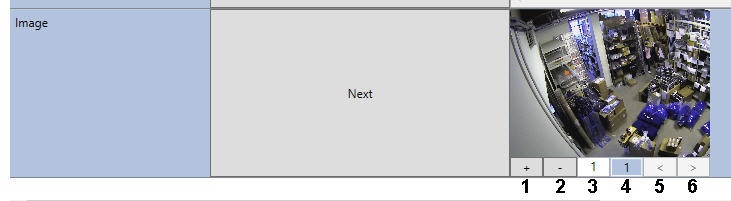
If you create and configure the Equipment detection (PPE) object for a camera, the outlines around detected objects can appear on the frame. The color and thickness of the outline are determined by the RectColor and RectLineThickness registry keys (see Registry keys reference guide).
- The element doesn’t have any images, and they need to must be uploaded. To do this, click the + button (1), and a standard Windows Explorer window will openopens, in which you can select an image file in JPG, PNG, or BMP format.
| Info | ||
|---|---|---|
| ||
An The event with the Acknowledged status is available for processing handling only by for the operator who took it. To release an the event without processinghandling, right-click the event and select Release:
|

After you complete all the stages, the event processing handling interface will close closes, and, if it was specified in the logic settings, a report will be displayed indicating the actions and the user who performed them is displayed (see see Interim report).
...
Suspend event handling
If the Operator proceeds operator goes to process handle another event without completing the processing handling of the current eventone, the event will have gets the Suspended status status, and the processing handling elements will become inactive. In this case, the event will be is unavailable for processing handling by other operators.
The operator can independently suspend the processing of an event handling if the appropriate permissions rights are given given (see see Configuring user rights in Incident manager). To do this, right-click on the event and select Suspend:
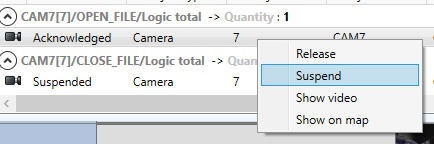
To continue processing handling the paused suspended event, right-click on the event in the table again and select Acknowledge.
Escalating events
Event escalation
In the settings, you can set the ability to transfer the event for handling to The ability to escalate an event for processing by another operator of the system can be enabled in the settings—escalating (see —escalation (see Configuring user rights in Incident manager). Escalate the event manually as follows
To escalate manually, do the following:
- Right-click on an the event in the table.

Click Escalate, and select to whom in the drop-down list, select who to escalate the event to::
All—escalation to all users, that is, any user can handle the escalated event.All—the escalated event can be taken into processing by any user;
Specific user from the list—the escalated event will be is assigned to this particular the selected user.
If you don't set the option to see and work with the escalated events isn't configured in the settings (see see Configuring user rights in Incident manager), after escalation, the event will disappear disappears from the list and will be is displayed for another operator with the Escalated/<Last name of the operator who escalated it> status. In this case, the event will be is in the state that it was at the time of escalation: if the operator started processinghandling it, then the event will be is at an the unfinished stage of processing.
Additionally, the events you can start escalating automatically escalate events after the specified time (see see Selecting events to display and handle). In this case, the automatically escalated event will become becomes unavailable for processing handling by the current operator and will be is displayed with the the Escalated/Waiting for processing statushandling status.
...
Handle an event group
Processing an Handling of event group groups is possible if it is enabled in the the Configuring the events event grouping in Incident incident manager. Possible options:
- After processing you handle one of the group events, all remaining events of this group will be are automatically closed.
- Only the first event of the a group is displayed in the event list display window. The rest of the group events will be are automatically closed after the first event is processedhandled.
- When you escalate one event in of a group is escalated, all events of the entire group are automatically escalated too.
If the operator processes handles an event from a group, all events of this group will be blocked are locked for other operators, and new events of the group will automatically change their status. In other words, all events of the selected group, including incoming new events, will be are available for processing handling only to one operator until they process handle all events of the a group. Other operators won’t be able to process cannot handle events from this group. When : if they try to process handle an event from this group, a the message "Group is blocked" will be locked is displayed.
| Info | ||
|---|---|---|
| ||
If the operator took handles one event from a group into processing and released releases it without processinghandling, the blocked locked events of the a group are released again for other operators. |
The color of the group name can also change during group processing, see Grouping eventshandling, see Event grouping.
...
Close events without
...
handling
If you set the ability to close events without processing them is enabled handling in the settings (see see Configuring user rights in Incident manager), then 2 two buttons are displayed in the upper right corner of the events event table:

- To Close. It is used to close one event; , select it from the required event in the table and click this the Close button.
- The Close all. It is button is used to close all events.
Also, by clicking the Close all button, you can close events of one or several groups selected in the Group by table.
| Tip |
|---|
Event statuses are described on the in Event information page. |
Overview
Content Tools