
Go to documentation repository


Page History
The Button object is a child object of the Camera system object and is used to display the Button over the a button on top of the video image received from the parent camera. This page describes how to configure the appearance of a Buttonbutton, as well as how to choose the action that will occur occurs when you click the Button is clickedbutton.
The Buttons display in the Video The button display in the video surveillance monitor must must be enabled beforehand. If no Button objects are object is created in the system, they are not a button isn't displayed.
| Note | ||
|---|---|---|
| ||
Several Buttons can be created for the Camera. You can create several Button objects for the Camera object. In this case, the preview window will display displays all created Buttonsbuttons, and the setting described below will be is applied only to the current (selected in the objects tree) Button, i.e., each Button button, that is, each button must be configured separately.
|

To configure the Button object, do the following:
- Go to the Hardware tab of the System settings dialog
- window (1)
- .
- Create the Button object on the basis of the Camera object (2)
- object.

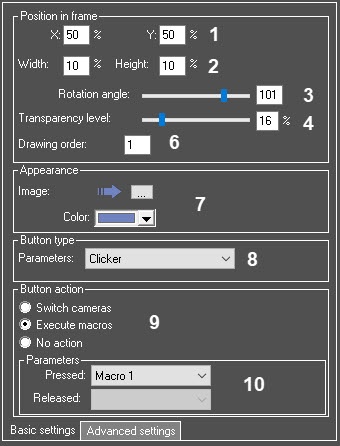
- Configure the position and display of the Button in the Surveillance
- the button in the surveillance window:
- The position of the top left corner of the
Button - button is set by
the - the X and Y fields (
3- 1). X
is - is the horizontal indent from the left border as a percentage,
- and Y
is - is the vertical indent from the top border as a percentage. For example, if you set 50 and 50, then the left top corner of the
Button - button will be in the middle of
the Surveillance - thesurveillance window.
in the Width and Height fields (4- thesurveillance window.
- In the Width and Height fields (2), set the size of the button as a percentage of the size of the
Surveillance - surveillance window.
set the - Set the Rotation angle
- (3) of the
Button - button in degrees from -180 to 180. By default, it is assumed that the button isn't rotated, the angle is zero
(5)- .
set the Set the Transparency level
of of the
Button button as a percentage (
64). The feature of this setting: the real transparency
will be is displayed in the preview area (
75) only when transparency is being edited with the slider. The rest of the time, the
Button button is completely opaque during
configuringconfiguration.

Info title Note You can configure the size and position of the
Button button not only by entering values
, but also manually. To do this, in the preview area, after clicking the
Buttonbutton, you can:
drag - Drag the
Button - button with the mouse
;- .
stretch - Stretch or shrink the
Button, - button and rotate it, using the green anchor points on its perimeter.
You can fine-tune the
Button button size and rotation angle manually: when Shift is pressed and when you drag the green circle with the mouse, the
Button will change button changes only its size. When Ctrl is pressed, the
Button will change button changes only its angle. When you press Shift+Ctrl
are pressed, the
Button wonbutton doesn't change.
set the Set the Drawing order
of of the configured
Button button in the corresponding field if several
Buttons Button objects are created for
one one Camera
object (
86). The setting determines the order in which the
Buttons buttons are drawn in the
Surveillance surveillance window.
- Select the Button action—what will happen when the Operator clicks the Button in the Monitor (9)
- appearance of the button (7):
- Click the Image button.
- Select the shape of the button in the Select image for button window.

- From the Color drop-down list, select the color of the button (for the Clicker button type only).
- Select button type (8):
- Clicker.
- Radio button.
- Select the Button action (9)—what happens when the operator clicks the button in the video surveillance monitor:
- Switch between the video images of the cameras. The cameras that
will be - are controlled by the
Button - button must be added to the Monitor window (
see - see Selecting and configuring video cameras), otherwise, you won’t be able to switch between the video images when you click the
Button- button.
- Execute macros.
The macros must be created - You must create macros beforehand (see Creating and using macros).
- No action.
From the Parameters drop-down list (10), select a specific action when clicking the Button. Possible - Select the button parameters (10):
- The Pressed drop-down list—possible values are determined by
what - the action
was - that you selected in the previous step: it can be both available macros and the list of cameras between which you can switch.
If - The Released drop-down list (active only if you select the Radio button button type)—available macros.
- On the Advanced settings tab, if necessary, set the
- the Button label in
- in the corresponding field (11). To display a default label for the Button depending
- button depending on the selected action, click the
- the Default button
- button (12). In this case, the label will contain the name of the camera, macro, or current object.

Info title Note In the
Video interface of the video surveillance monitor
interface, the label is displayed only as a tooltip when you hover the cursor over the
Buttonbutton.
- Click the
- Apply button.

As a result, the Monitor will the monitor will display the Button over button on top of the video image received from the Camera on camera, on the basis of which this Button was createdbutton was created.
You can configure the mode of displaying the button in the video surveillance monitor using the parameter of the AllowHideActionButtons key of the HKEY_LOCAL_MACHINE\SOFTWARE\AxxonSoft\PSIM\Video registry. To always display a button, set AllowHideActionButtons=0 (see Registry keys reference guide. For the information on working with the registry, see Working with Windows OS registry).
Configuring a button to display in the video surveillance monitoris complete.
| Note | ||
|---|---|---|
| ||
When you upgrade Axxon PSIM 1.0 to Axxon PSIM 2.0, the button changes position, since the coordinates in version 2.0 are set for the center of the button and not for the upper left corner. This is done so that the button can be partially hidden behind the screen. |
Overview
Content Tools