
Go to documentation repository


Page History
...
| Section | |||||||||||||||||||||
|---|---|---|---|---|---|---|---|---|---|---|---|---|---|---|---|---|---|---|---|---|---|
|
All events registered in the system or those events that match preconfigured filters are displayed in the Event viewerThe Event viewer window displays all messages registered by the system or messages of a certain type according to the preconfigured filters.

| Note | ||
|---|---|---|
| ||
You must create a blank filter (i.e. filter with blank columns) in order to display If you want to view all events for all objects in the system in the the Event viewer . All events are also window, you must create a blank filter, that is, a filter in which all columns are left blank. Also, all events are displayed in the Event event viewer when if there is no filter at all (, see Configuring event filters for displaying in the Event viewer). If you delete all previously created filters, an "empty" filter will be left. When selected, it will display all events. a blank filter is left. If you select it, all events are displayed. To view events while controlling the The events display while using PTZ devices (cameras with telemetry) is managed by , use the SendEventToCore=1 parameter of the HKEY_LOCAL_MACHINE\SOFTWARE\WOW6432Node\AxxonSoft\PSIM\Telemetry registry key (for more details, see Registry keys reference guide; for information on working with the registry, see Working with Windows OS registry). |
Filters
The Show filters checkbox opens displays the list of event filters configured while during the system setup (see Configuring event filters for displaying in the Event viewer). To activate the filter, set the checkbox next to it's its name. Several filters can be activated You can activate several filters simultaneously. Options for using filters are described in the table:
| Filter use option | Filter settings made beforehand | Result in the Event viewer |
|---|---|---|
| Filter The checkbox is set next to the filter | Certain objects and their events are selected | Only events that match the filter are displayed |
| Several filter checkboxes The checkboxes next to several filters are set | Certain objects and their events are selected in each of the filters | Only events that match at least one of the selected filters are displayed |
| No filter is selected (all filter checkboxes next to filters are clearcleared) | Certain objects and their events are selected in each of the filters | Only events that match at least one of all created filters are displayed |
| The checkbox next to the "EmptyBlank" filter checkbox is set | No object or event is selected | All events from all system objects are displayed |
There are no filters created for the Event event viewer in the system, there are no filter checkboxes availableis nothing to apply | NA- | All events from all system objects are displayed |
The selected filters and the filter display settings remain the same after selection of filters as well as the settings for displaying the filter lists are saved when Axxon PSIM is restarted, i.e. if that is, if you select certain filters are selected and hide the list of filters is hidden, then after you restart Axxon PSIM, the Event event viewer will display displays events according to the previously selected filters.
Events of different types are highlighted in different colors depending on the filter settings. The string color may change to another custom color or color of the event string can change or return to the default color after filter switchingwhen you switch filters.
A Besides, there is the dynamic filter in the top of a column can be applied to show column headers that allows displaying only events from the objects satisfying matching the search condition. This filter The entered condition is applied by pressing when you press the Enter key.
...
Working with the
...
list of events
The Event viewer window displays a the table containing a the list of the events registered by the system , which are broken down according to object for the objects of a certain type. The object types , for which the registered events are displayed in the Event event viewer, as well as the number of events simultaneously displayed within one event window, are specified at the system configuration stage.
...
By default, events are sorted by the date and time in the Event viewer window. Events You can be sorted sort events by any of the columns. To enable or disable sorting, left-click the header of the required column. When changing the you change filters, the sorting is saved.
When sorting you sort by time, new events are added to the end of the list in the Event viewer window. The list is scrolled in such a way that the last event is always displayed and highlighted in the window and selected. When the you select an event ( different from the last one) is selected, the list is fixed, and there is no scrolling , stops; new events are added to the end of the list. Scrolling is resumed You can resume scrolling in the following cases:
- The last event in the list is selected. This can be done You can do it by using the Ctrl+End or Ctrl+Home key combinations on the keyboard shortcuts.
- The user did not doesn't perform any actions in the interface window for three minutes. This time can be changed You can change this time by using the UserActivityTimeout registry key—see key—see Registry keys reference guide.
- The list was is sorted by the new column, or the filter was is changed.
The table gives the following data for each event:
| Column name | Source | Event | Region | Add. info | Card | Date and time |
| Description | Source object The ID of the event source object. Note. The information in this column is received This column displays the information from the objid column of the dbo.PROTOCOL table of the Axxon PSIM database | Event name. Note. The information in this column is received This column displays the information from the action column of the dbo.PROTOCOL table of the Axxon PSIM database | Conventional field (region) of the event source object locationThe ID of the region where the event occurs. Note. The information in this column is received from the This column displays the information from the region_id column of the dbo.PROTOCOL table of the Axxon PSIM database | Additional information describing about the event (if any). Note. The information in this column is received from the This column displays the information from the param0 column of the dbo.PROTOCOL table of the Axxon PSIM database | Card code for the access-related events (i.e. for example, ACCESS_IN). Note. The information in this column is received from the This column displays the information from the param3 column of the dbo.PROTOCOL table of the Axxon PSIM database | Date and time of the event. Note. The information in this column is received from the This column displays the information from the date column of the dbo.PROTOCOL table of the Axxon PSIM database |
| For details about the dbo.PROTOCOL table, see Base Axxon PSIM database tables. | ||||||
Additionally, a symbol near the source object the icon next to the name of the event reflects source object displays the current status of the given source object.
The Clear button is used to clear the list of events in the Event viewer window.
| Info | ||
|---|---|---|
| ||
| After you clear the Event viewer is cleared and if hidden events are to be displayed again, then window, restart Axxon PSIM must be restarted with the Load protocol checkbox set (see if you want to display the hidden events again (see The parameters of the Event viewer). |
Event source objects
To show display the actual location of the an object on the Mapmap, use select the Show on map item in the function menu of the source object. As a result, the Map will be displayed. It will contain map containing the source object opens (see Working with the Mapmap). The corresponding object is highlighted outlined with green dots and marked with concentric black-and-white circles.

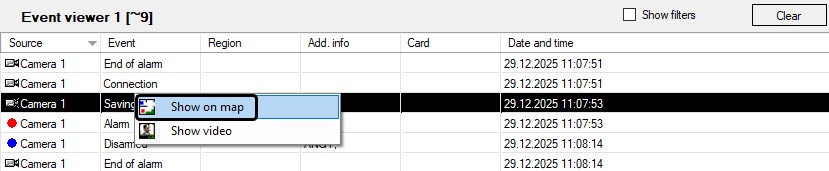
To playback play back the video of the event from the event source camera, use Saving to disc event, select the Show video item in the function menu of the Camera object (source object).

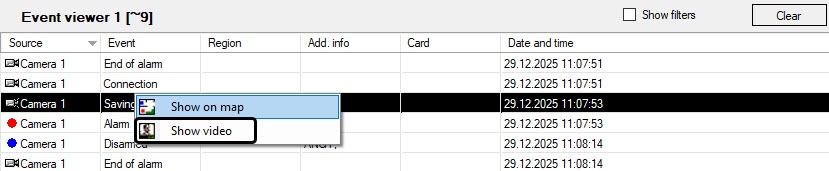
In the opened child window that opens, the Surveillance surveillance window will be is displayed in the archive playback mode.
...
The current playback position will be is set to the position corresponding to the start of the video recording start time.
You cannot change the video source object in this video surveillance window.
| Info | ||
|---|---|---|
| ||
If the detection of you configure the option for detecting the abandoned objects is configured (see the Configuring smart video detection tools), abandoned objects are framed in the video outlined when you play back the video.
|

...
Overview
Content Tools