
Go to documentation repository
...

On the Select area tab (1), set the surveillance zones. You can set several surveillance zones (2). Detector generates a separate event in each surveillance zone.
| Info | ||
|---|---|---|
| ||
Both the vehicle stop and the stopped vehicle that leaves the boundaries of the zone are detected in each surveillance zone. |
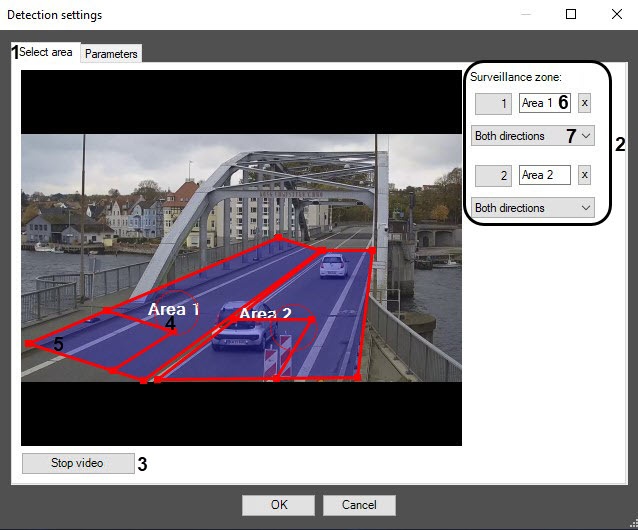
To set the surveillance zone, do the following:
Click the Stop video button (3) to capture the frame of the video image.
To add a zone, click the left and right mouse buttons on the frame of the video image.
Specify the approximate size of the vehicle in each surveillance zone by changing the size of the internal area in the bottom left corner of the zone (5). This area (5) is called the detection area.
| Info | ||
|---|---|---|
| ||
Each surveillance zone over its entire area is proportionally covered by detection areas of the specified size. You must set the approximate dimensions of the vehicle so that each surveillance zone includes no more than 256 detection areas.
|
Select the direction of vehicle movement relative to the camera for the surveillance zone (7).

In the Frames processed per second [0.016, 100] field, enter the number of frames that the detector processes per second. The higher the value, the more accurately the detector operates, but the higher the load on the CPU. The default value is 25 frames.
| Info | ||
|---|---|---|
| ||
You can find all events received from the Stopped vehicle detection object in the Event viewer interface window. For more details, see Operating the Stopped vehicle detection module. |
...

