
Go to documentation repository


Page History
By default, the entire frame is analyzed. If you want to analyze only a certain area, you must specify one or more areas where detection and metadata generation will be performed.
To do this, do the following:
- Select a detection tool
- detector and click the
 button.
 - In the Surveillance
- surveillance window, click the mouse button.
- Select Skip
- Detection area in the list.
- In the Surveillance
- surveillance window, set the anchor points of the area ,
- within which the detection will be performed.
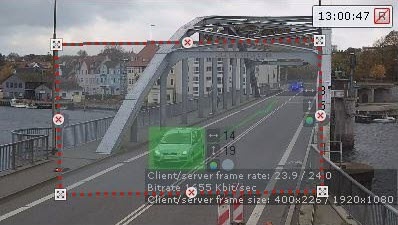
Info title Note - Depending on the detector being configured, the area can be either rectangular or polygonal.
- When you set anchor points, they are connected by a two-color dashed line outlining the border of the area.
- For convenience of configuration, you can "freeze" the frame. Click the
 button. To cancel the action, click this button again.
 Once the area is closed,
the the

buttons buttons are available on its borders between the anchor points. When you click them, a new anchor point is added, allowing you to specify the most precise areas possible.
- To delete a selected area, click the
 button.
Action Result Left-click or right-click in the Surveillance surveillance window Creates a new anchor point of the area Right-click a created anchor point Deletes an anchor point of the area Hover the mouse cursor over an anchor point and, holding down the left mouse button, move the mouse Moves an anchor point of the area Specify all required detection areas.
- Click the Apply
 button. To cancel the changes, click the
 - the Cancel
 button.
Configuration of a detection area is complete. Detection areas are relevant for all sub-tools detectors (except for for Line Crossingcrossing) created on the basis of the parent detection tooldetector.
Overview
Content Tools