
Go to documentation repository


Page History
By default, an operator is forbidden to administer any objects. If an operator is granted access to one or more tabs of the the System Settingssettings window, they automatically receive the rights to administer, control, and view all system objects on these tabs.
When the operator has the rights for control functions, they can use the buttons, menu items, and other interface elements allowing to control the corresponding objects (cameras, microphones, telemetry, event viewer, etcand others). In addition to overall restriction of object control functions, the separate commands can be prohibited (see Limiting access rights to sending send commands (reactions)).
Viewing functions allow the operator to view the interface components (user screens, surveillance monitors, Backup archive window, microphone indicators, etc.).
By default, an operator can have a full access to administrator, operator, operator and control functions of the objects with the given functions. It is possible to ban prohibit the operator to administer from administering one or several objects, limit the list of available functions of object control, and also limit monitor monitoring opportunities.
| Info | ||
|---|---|---|
| ||
If the administrator password is not set (see Administrator password registration) and the access to the required tabs of the System settings dialog window is limited (see Limiting access to the tabs of the System Settings settings window), then the limitation of the object configuration rights will not be available. |
...
- Open the Users tab in the System Settings window (1).
Open the required User permissions object rights object in the objects tree under the User permissions button rights button (2).
The settings panel for this object opens on the right side of the System Settingssettings window.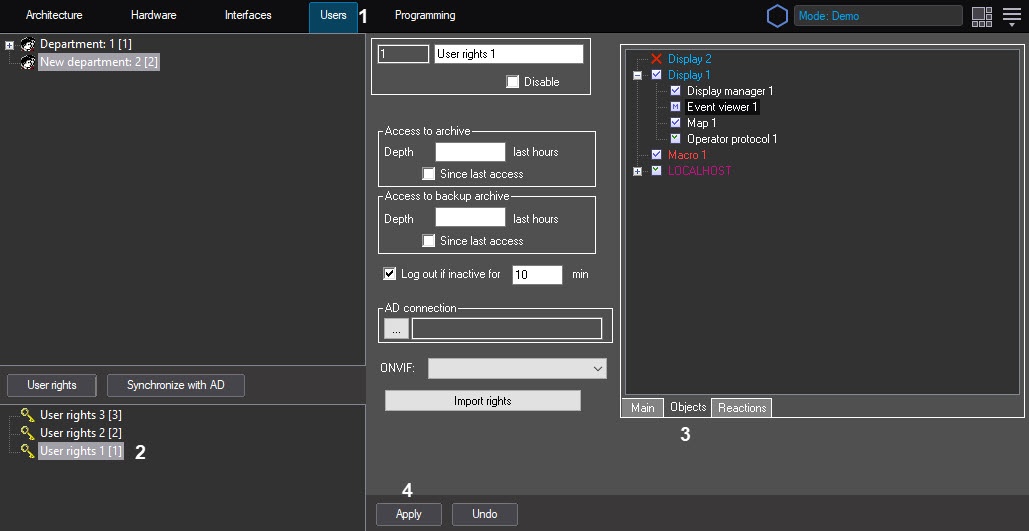
Go to the Objects tab (3). The tree in the lower part of the settings panel represent the object tree corresponds to the rights of the current Axxon PSIM operator. Checkboxes In the object tree, to the left of the objects indicate and allow changing the administrative, control or viewing rights for these objects. The components of the tree represent the system objects which the current user can administer according to their rights’ settings. Name of marks corresponds to object names, which administration, control and monitoring may be accessible to Operator with proper rights (3).
Correspondence of mark type to Operator each object, there is a field that can be edited—it indicates the jperator’s rights to administer, control, and view system objects. The names of the icons correspond to the names of objects, the administration, control, and viewing of which can be available to the operator with the appropriate rights. The correspondence of the icon type to the operator’s rights is given in the table.Icon
Type of markIcon image
Right to administer
Right to control the object
Right to monitor view the object
Large grey-blue flag

Yes
Yes
Yes
A Small green mark flag

No
Yes
Yes
An M mark

No
No
Yes
A cross mark x X

No
No
No
Info title Note The administrative, control, or viewing rights to interface objects depend on the rights to the Computer objects. The rights to the Computer object have a higher priority. For example, if the user rights allow the administration of the Display object , but prohibit the administration of the Computer object to which this Display is assigned, then a user logged on to the computer prohibited for administration will not be able to administer the Display object (see also Assigning the displays to the operator workstations).
...
- After finishing the setting, click the Apply button(4).
The following hotkeys can be used for objects object tree control:
| Key | Function |
| "+" on the numeric keypad | Grants all rights to the selected objects (sets the gray mark) |
"-" on the numeric keypad | Forbids the selected object (sets the red cross) |
| "Space" | Sequential change of the rights to the selected object in the direction of increasing (forbidden-monitoring-control-administration and then cyclically). |
| "Left " and " right " arrows | Expand / collapse the selected tree branch. |
| "/" on the numeric keypad | Fully collapse the selected branch of the objects tree |
| "*" on the numeric keypad | Fully expand the selected branch of the objects tree |
| "Shift" + "/" on the numeric keypad | Fully collapse all branches of the objects object tree. This view will be saved for the current user even after Axxon PSIM restart. |
| "Shift "+ "*" on the numeric keypad | Fully expand all branches of the objects object tree. This view will be saved for the current user even after after Axxon PSIM restart. |
Expanding and collapsing the tree functions are also available when you right-click on an object in the object tree (see The Expand tree function and The Collapse tree function).

Overview
Content Tools