
Go to documentation repository


Page History
| Section | |||||||||||||||||||||
|---|---|---|---|---|---|---|---|---|---|---|---|---|---|---|---|---|---|---|---|---|---|
|
General info
The RTSP The rtsp Server object is used for transmitting video from Server to remote workplaces using the RTSP protocol. Use of the RTSP protocol allows viewing video from IP cameras and video archive on remote clients by means of the Intellect software or using video players that support this protocol. Transmitting Video gate archive and Long-term Backup archive is also supported.
If there is sound with live video or the archive is recorded with sound, then video broadcast with sound through RTSP Server is supported—for this specify the ID of microphone from which the archive is recorded when requesting video (see the table with requests examples). For proper operation of this feature set the VLC media player compatibility mode checkbox checked in VLC Media Player (see item 14).
| Note | ||
|---|---|---|
| ||
Transmitted video stream is to be compressed using H.264, H.265, MPEG4 or MJPEG codecs. When MJPEG codec is in use, video of height and/or width more than 2048 pixels is not supported. The client is to reconnect to URL when the codec is changed. To view the archive via RTSP Server, the archive should be recorded in the same codec. Otherwise, the archived video will not play. |
It is to be taken into account that while configuring each rtsp Server loads only one CPU core. To increase the number of rtsp streams several rtsp Server objects are to be created and configured on several cameras. Each RTSP Server entity runs in a separate system process (StreamingServer.run).
| Info | ||
|---|---|---|
| ||
All the ports mentioned below are specified using only natural numbers. |
Creating the RTSP Server object
Create the RTSP Server object as follows:To create and configure the rtsp Server object, do the following:
- In the context menu of the Computer object select Create object => rtsp → RTSP Server.
- Specify the name and ID of the object in the opened panel.
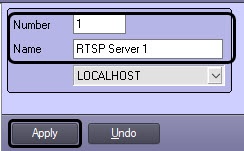
- Click the Apply button to create the object.
Configuring the Unicast mode
- Open the settings panel for the rtsp RTSP Server object. For this select the created object in the Intellect objects tree.
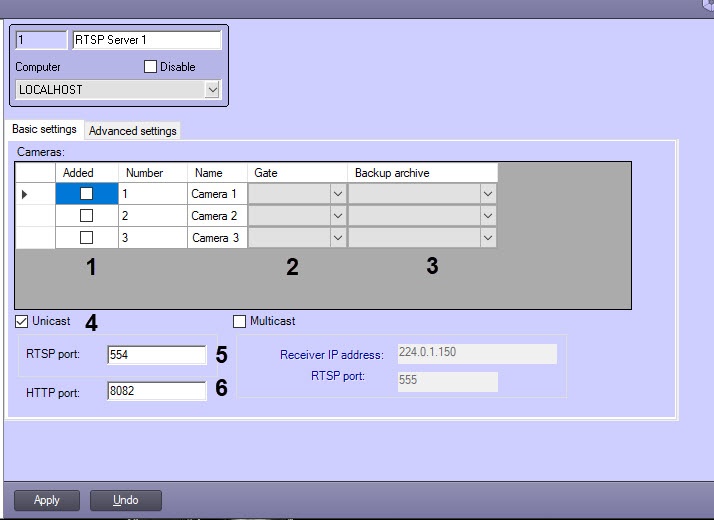
In the Cameras table set the checkboxes next to video cameras video from which is to be displayed (1). If camera has several streams, the default stream is broadcasted.
Info title Note. To select several cameras at the same time, mark lines in the table and then holding down the Ctrl key on the keyboard click the unchecked box in one of the marked lines. 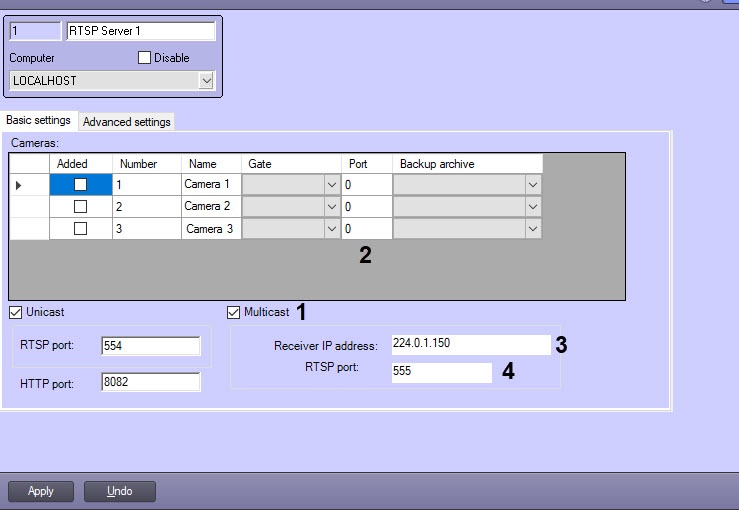
As a result all selected lines will be set checked.
To uncheck several boxes at the same time, do the same, but click the checked box after the selection of the lines.If default stream is changed on the corresponding Camera object settings panel after applying RTSP Server settings, it is mandatory to click Apply on the RTSP Server object settings panel to apply changes to it as well. See also Configuration of multistream video.
- If video from the camera is to be received through the video gate, then select the Video gate object in the Gate drop-down list (2).
- If archive from the camera is to be received from the backup archive, then select the Backup archive object in the Backup arch. drop-down list (3).
- If video from the camera is to be received through the video gate, then select the Vide ogate object in the Gate drop-down list (2). Set the Unicast checkbox checked if signals from all cameras are to be broadcast through one port (4).
In the RTSP port field specify the port via which the video is transmitted (35).
Info title Note. The "Windows Media Player Network Sharing" service service can use the default port 554. Change the port number or disable this service for translationbroadcast.
To disable the service go to the Control panel - → Administrative Tools - → Services and double-click on the service name and click the Stop button in the opened window.- In the HTTP port field specify the port that is to be used for transmitting video via http-protocol (46).
Configuring the Multicast mode
Features of the Multicast mode:
- To get a multicast video in Intellect (see Configuring multimedia receipt using RTSP protocol) set the multicast value to the RTSP parameter in the HKEY_LOCAL_MACHINE \SOFTWARE\ITV\Intellect\Video\TransportProtocols registry section (for 64-bit system the path is HKEY_LOCAL_MACHINE\SOFTWARE\Wow6432Node\ITV\Intellect\Video\TransportProtocols) on computer where the Camera object is created. For detailed information on this parameter, see Changing the transport protocol used by IP-device.
- RTSP Server can broadcast simultaneously in Multicast and Unicast modes. Receiving both such streams on the Intellect client is impossible due to RTSP key which determines the connection mode (see above). However, the VLC player allows receiving streams in both modes in the same time.
- The ports that are assigned to each camera in this mode will not be displayed in the Windows OS Resource Monitor and other similar operating system resource monitors.
Using the Multicast mode allows you to reduce the load on the Server by reducing the amount of transmitted data. To distribute the transmitted signal among different RTSP ports, do the following:
- Go to the RTSP Server object settings panel.
Set rtsp-ports set the Multicast checkbox (1). In the Cameras table the The Port column is displayed . Every video camera is to have in the Cameras table.
Specify a data transmission port for each video camera in the Port field (2).
Note title Important! Bear in mind the following when specifying ports:
- The following ports are in use for each camera in the Multicast mode: nPort, nPort + 18000 (rtp), nPort + 19000 (rtcp), where
Info title Note- nPort—port number specified for camera in the Port column.
For proper operation of RTSP server in the Multicast mode these ports are to be vacant.
Info title Note. Use of the Multicast mode allows decreasing Server load due to reduction of transmitted data. - Specified ports are not addressed directly. Use RTSP port to get video from all cameras in the Multicast mode (see item 12).
In spite of specifying video data port it is required to specify camera number in the data source address (see the table below).
Info title Note. To get such video in the Intellect software (see Configuring multimedia receipt using RTSP protocol) set the multicast value to the rtsp parameter in the HKEY_LOCAL_MACHINE \SOFTWARE\ITV\Intellect\Video\TransportProtocols registry section (for 64-bit system the path is HKEY_LOCAL_MACHINE\SOFTWARE\Wow6432Node\ITV\Intellect\Video\TransportProtocols) on computer where the Camera object is created. Detailed information on this parameter see in Changing the transport protocol used by IP-device section.
In the Receiver IP address field enter (3) specify the address from which the broadcast in Multicast mode will be performed. Address is to be in range from 224.0.01.0 to 239.255.255.255 (3). By default, the receiver IP is 224.0.1.150.
Note title Important!Bear in mind the following when specifying Receiver IP address:
224.0.0.0-224.0.0.255 address range is reserved for routing protocols and other service protocols. Destination IP address cannot be set from the specified range
Info title Note.
RTSP-server can broadcast to one network simultaneously. The network with minimal metric is selected
by default. To change the broadcast network
, go to the Advanced settings tab (see below).
- Set different Receiver IP address and RTSP port if several RTSP Servers are in Multicast mode.
- In the RTSP port field (4) specify the number of port through which video signal will be sent in the Multicast mode. When requesting video data from the camera using the RTSP protocol, it is necessary to specify this port. The system itself forwards the request to the port of the requested camera.
Additional settings
Perform the additional settings as follows:
- Go to the Advanced settings tab.
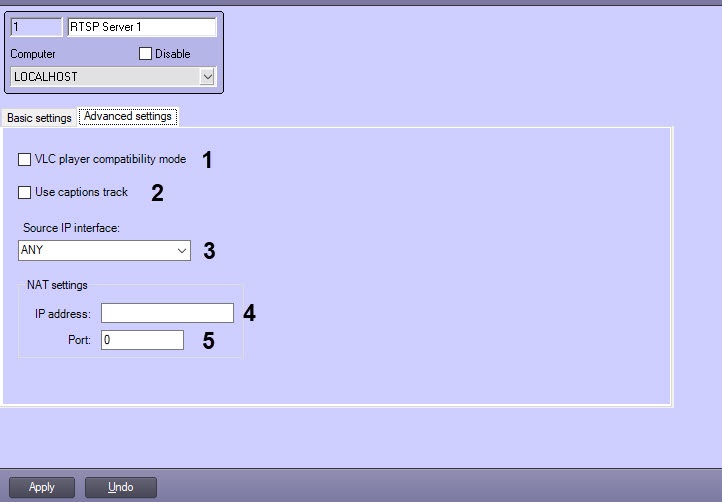
If the current time is to be sent to VLC Media Player instead of the frame time, then set the VLC player compatibility mode checkbox checked (1). This option is to be used in case of problems when playing back the archive received over RTSP in VLC Media Player.
If there are captions on the video (see Configuring captions display on a video image), set the Use captions track checkbox checked to send them along with video via RTSP Server and to display them in the receiving app—VLC player (2).
Also, when this checkbox is set, time captions are added to the video image in the format YYYYMMDDTHHMMSSZ. If the video is archive (see request examples below), then the captions show the archive time. However, if the VLC player compatibility mode is set along with the Use captions track check box, the time in the captions is current.Note title Attention! Correct video and captions operation are enabled only in VLC Media Player 2.0.0. These features are not guaranteed to work in other versions of VLC Media Player or other programs.
From the Source IP interface drop-down list, select the name of the network interface that should be used to broadcast the RTSP server (3).
If the RTSP Server is used for broadcasting the video data to the Single Data Center (ECHD), and the Video Surveillance Servers are behind NAT, then it is necessary to specify the NAT settings:
In the IP address field, specify the IP address of the router that performs the NAT broadcasting (4).
In the Port field, specify the port of the router, which is accessed by the client when executing the Single Data Center (ECHD) requests (5).
Info title Note To enable the substitution of the router's specified IP address and port to the Single Data Center (ECHD) requests, it is necessary to set the corresponding checkbox in the settings panel of the Web server object—see Enabling the processing of ECHD requests and selecting rtsp server.
Click the Apply button to save the changes.
The rtsp Server object is now configured.
Bulk settings for cameras
In case any changeable setting should be the same for several cameras, there is a possibility of bulk setting. This feature is available for editable columns: Added, Gate, Port, Backup Archive.
Perform bulk setting of cameras as follows:
- Go to the settings panel of the RTSP-Server object.
- Set the value of one or more reference parameters Added, Gate, Port, Backup Archive for one of the Camera objects.
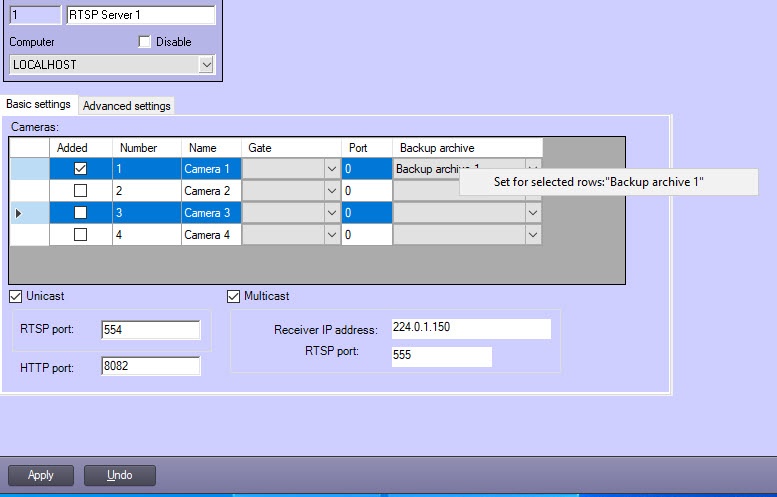
- While holding down the Ctrl key, select the (full) rows in the table, which should have the same values in the corresponding columns.
- Right-click in the reference cell.
- In the opened function menu, select Set for selected rows: "Value". As a result, the corresponding column in all selected rows are filled the value equal to the reference parameter.
- Repeat steps 4-5 for all parameters that need to be applied to the selected lines.
Examples of addresses to receive video from RTSP Server
To connect to Server and display video in the video player that supports RTSP protocol, specify the address of data source in the format given in the table:
| Info | ||
|---|---|---|
| ||
The time parameters time_begin and time_end must be specified in UTC+0. |
Address | Example | Description |
rtsp://ServerIP address[:Port]/CameraNo |
[?stream_id=StreamNo] | rtsp:// |
127. |
0.0. |
1/1 | Viewing |
default stream from Camera 1 if default port is in use. |
| rtsp:// |
| 127.0.0. |
| 1:555/1 |
Viewing default stream from Camera 1 when broadcasting in Multicast mode if default port 555 is in use |
. Note. Connection to the RTSP stream is performed via the broadcasting adapter IP-address, not by the destination IP which is specified in the settings panel of the RTSP Server and is used internally | |
| rtsp://127.0.0.1:555/7?stream_id=7.2 | Viewing second stream from Camera 7 |
| rtsp://Login:Password@ServerIP address[:Port]/CameraNo |
| rtsp://login: |
| pass@127. |
| 0.0.1:554/1 | Viewing video signal from Camera 1 if users and permissions are configured in Intellect |
| (see Rights administration) | ||
| rtsp://login:pass@127.0.0.1:555/1 | Viewing video signal from Camera 1 in Multicast mode if users and permissions are configured in Intellect | |
| rtsp://Server IP address[:Port]/CameraNo?mic_id=Microphone ID | rtsp://127.0.0.1:555/15?mic_id=1 | Viewing video from Camera 15 with sound |
| rtsp:// Server IP address[:Port]/?mic_id= Microphone ID | rtsp://127.0.0.1:555/?mic_id=1 | Getting sound only from microphone 1 with no video from any camera |
rtsp:// ServerIP address[:Port]/archive?id= CameraNo.&time_begin=yyyy.mm.dd-hh:mm:ss&time_end= yyyy.mm.dd-hh:mm:ss | rtsp://127.0.0.1:554/archive?id=1&time_begin=2011.11.11-11:11:11&time_end=2011.11.11-11:12:00 | Viewing video archive from Camera 1 for specified time period |
| rtsp:// Server IP address[:Port]/archive?id=CameraNo&mic_id= Microphone ID &time_begin=yyyy.mm.dd-hh:mm:ss&time_end= yyyy.mm.dd-hh:mm:ss | rtsp:// |
| 127. |
| 0.0. |
| 1:554/archive?id=1&mic_id=1&time_begin=2011.11.11-11:11:11 |
| &time_end=2011.11.11-11:12:00 | Viewing video archive from Camera 1 with sound from microphone 1 for specified time period |
| rtsp://ServerIP address[:Port]/archive?id=CameraNo.&time_begin=yyyymmddThhmmssZ&time_end= |
| yyyymmddThhmmssZ | rtsp:// |
| 127. |
| 0. |
| 0. |
| 1:555/archive?id=1&time_begin=20160331T080000Z&time_end=20160331T080800Z | Viewing video archive from Camera 1 for specified time period |
| rtsp://ServerIP address[:Port]/archive?id=CameraNo.&time_begin=yyyymmddThhmmssZ | rtsp:// |
| 127. |
| 0. |
| 0. |
| 1:555/archive?id=4&time_begin=20160316T065000Z | Viewing video archive from Camera 4 from specific start time till the archive end (as the value of time_end is not specified in the address) |
| rtsp://ServerIP address[:Port]/archive?id=CameraNo |
| rtsp:// |
| 127. |
| 0. |
| 0. |
| 1:555/archive?id=4 | Viewing video archive from Camera 4 from the beginning till the end |
| rtsp://ServerIP address[:Port]/archive?id=CameraNo.&long_term_archive= |
| BackupArchiveNo | rtsp:// |
| 127.0. |
| 0. |
| 1:559/archive?id=1&long_term_archive=2 | Viewing Camera 1 video archive from |
| Backup archive 2 |
| rtsp://Server IP address[:Port]/archive?id=CameraNo.&gate= |
| VideogateNo | rtsp:// |
| 127.0. |
| 0. |
| 1:559/archive?id=1&gate=3 | Viewing Camera 1 video archive from Video gate 3 |
| rtsp://Server IP address[:Port]/archive?id=CameraNo. |
| Info | ||
|---|---|---|
| ||
| If 554 port is in use (default value,) it can be not specified in the address line. |
...
| &time_begin=yyyymmddThhmmssZ&time_end=yyyymmddThhmmssZ&z=PlayBackSpeed | rtsp://127.0.0.1:554/archive?id=2&time_begin=20171120T102000Z&time_end=20171120T104000Z&z=-1 | Speed-down playing back video archive of Camera 2 for the specified period of time. Value of z parameter greater than 0 (valid values are 2, 4, 6 ... 16) enables speed-up archive playback. If the parameter z is less than 0 (valid values are -1, -2, ... -16), then the archive is played back in the reverse order with the corresponding acceleration. Only key frames are played back at reverse playing |
| rtsp://Server IP address[:Port]/archive?id=CameraNo.&time_begin=yyyymmddThhmmssZ&time_end=yyyymmddThhmmssZ&long_term_archive=BackupArchNo | rtsp://127.0.0.1:554/archive?id=2&time_begin=20201117T110200Z&time_end=20201117T114900Z&long_term_archive=1 | Retrieve camera 2 records from backup archive 1, starting from 14:02:00 UTC+4 on 11/17/2020 and ending at 14:49:00 UTC+4 on the same day. time_begin and time_end in the request are UTC+0 times. The specified Backup archive must be selected for the corresponding camera on the settings panel of the RTSP Server object. VLC player compatibility mode must be enabled to view in VLC Media Player |
| Info | ||||
|---|---|---|---|---|
| Correct video and captions operation are enabled only in VLC player of latest versions. This features are not guaranteed to work in VLC Media Player 2.0.0 or older and other programs.||||
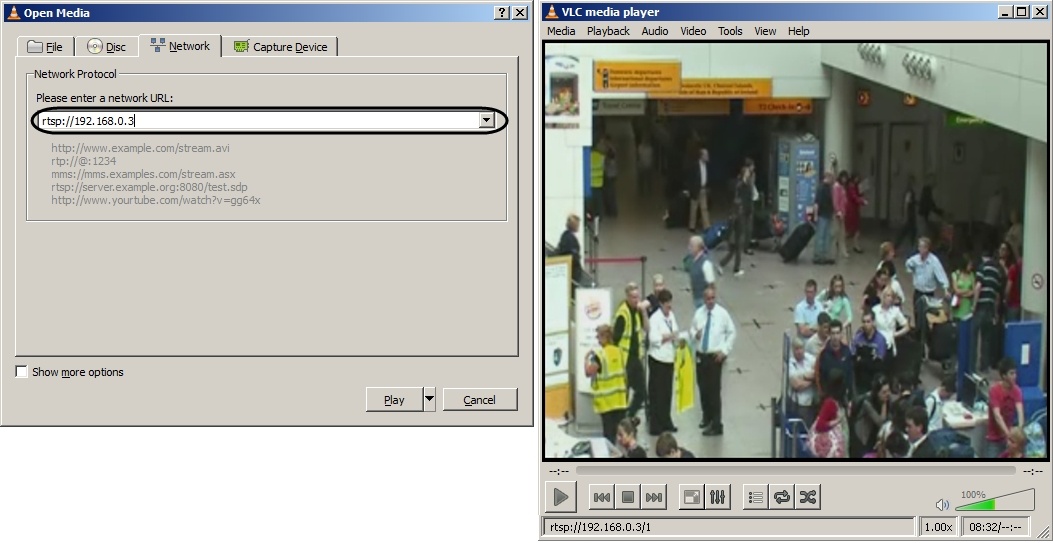
If 554 port is in use (default value), it can be not specified in the address line. In the examples given above specify the IP address of the computer where the RTSP Server object is instead of 127.0.0.1. |
The figure shows how to view video from the Server.
Overview
Content Tools