Requirements for the operation of the License plate recognition VT and its sub-detectors are given in the table:
| Camera | | Note |
|---|
| Correct operation of the detector isn't guaranteed if you use frames that were masked before they got into Axxon One by an IP camera or similar methods. |
|
...
| Panel |
|---|
| borderColor | #CCCCCC |
|---|
| bgColor | #FFFFFF |
|---|
| titleBGColor | #F0F0F0 |
|---|
| borderStyle | solid |
|---|
| title | On this page: |
|---|
|
|
...
To ensure the recognition of state license plates using the License plate recognition (VT), it is necessary to install and configure video cameras in such a way that the requirements described below are met.
General requirements
...
- In order to recognize state license plates on highways,
|
...
...
- must have the Global Shutter mode
|
...
...
...
...
Character height for IP cameras is at least 20-30 px, for analog cameras—at least 14-20 px, the stroke width is at least 2 px. If it is necessary to recognize two-line license plates, then these requirements are relevant for each line
|
...
The minimum allowable contrast in case of even staining of the license plate must be at least 20% (contrast visibility of characters relative to the background is 25 units with a 256-point scale).
...
The maximum allowable uneven staining is not more than 12% (the ratio of the stained area to the total area of the license plate).
...
The geometric proportions of the image must not differ by more than 10% from the geometric proportions of the state license plate itself.
| Info |
|---|
|
For MPEG-4 and H.264 formats, the recommended distance between key frames is no more than 4-8 frames in case of a stable connection. |
| Note |
|---|
|
- Correct operation of the detection tool isn't guaranteed if you use frames that were masked before they got into Axxon One by an IP camera or similar methods.
- The maximum vehicle speed for correct license plate recognition is limited to 180 km/h.
|
Video camera requirements
...
...
. The table below provides an example of the correlation between the viewing angle, sensor size, and lens focal length. For calculations, a standard video surveillance calculator was used
|
...
: | Expand |
|---|
| title | Expand the table with focal length settings |
|---|
|
| Distance to the object, m | Object width, m | Focal length, mm | Viewing angle, degrees | Sensor size, inches |
|---|
| 3 | 4 | 4 | 85 | 1/3 | | 3 | 4 | 5 | 65 | 1/2 | | 3 | 3 | 5 | 65 | 1/3 | | 3 | 3 | 6 | 55 | 1/2 | | 7 | 4 | 8 | 40 | 1/3 | | 7 | 4 | 10 | 35 | 1/2 | | 7 | 3 | 10 | 35 | 1/3 | | 7 | 3 | 12 | 25 | 1/2 | | 11 | 4 | 13 | 28 | 1/3 | | 11 | 4 | 18 | 22 | 1/2 | | 11 | 3 | 18 | 22 | 1/2 | | 11 | 3 | 23 | 16 | 1/2 | | 15 | 4 | 18 | 22 | 1/3 | | 15 | 4 | 23 | 16 | 1/2 | | 15 | 3 | 23 | 16 | 1/3 | | 15 | 3 | 30 | 12 | 1/2 |
|
|
...
Camera must have a lens with an aperture of f/1.0, f/1.2, f/1.3, f/1.4, or f/1.8
|
...
Color space model: Y800, RGB32, RGB24, YUY2, or UYUY
|
...
...
...
...
...
...
...
speed: | Expand |
|---|
| title | Expand the table with shutter speed settings |
|---|
|
| Shutter speed, s | Maximum vehicle speed in the surveillance area, km/h |
|---|
| 1/200 | 18 | | 1/250 | 22 | | 1/500 | 45 | | 1/750 | 68 | | 1/1000 | 90 | | 1/1500 | 136 | | 1/2000 | 181 |
|
|
...
...
- photomatrix suitable for license plate recognition. When selecting a camera, we recommend you to rely on a comparison of the photomatrix characteristics obtained as a result of measurements in accordance with the EMVA 1288 standard. This standard was developed by the EMVA (European Machine Vision Association) and it is offered to video camera manufacturers as a way to unify product evaluation methods. Requirements for the photomatrix for the License plate recognition VT are described in the table below:
| Expand |
|---|
| title | Expand the table with requirements for photomatrix |
|---|
| | Sensor type | Both CCD and CMOS sensors are suitable for license plate recognition. CMOS is preferred because it does not have the blur effect that is common with CCD sensors | | Sensor size | 1/3 inch or more. During recognition, the physical size (area) of an individual pixel in a sensor is more important than the physical size (area) of the sensor itself. Larger pixel size provides better recognition in low-light conditions | | Pixel size | 3.75 micrometers (µm) or more. The larger the sensor pixel size (area), the higher its sensitivity | | Sensitivity | Dynamic range of 60 decibels or more (approximate contrast ratio of 1:1000). |
|
|
...
We recommend using the wide dynamic range (WDR) function. It improves the quality of recognition in high-contrast lighting conditions—it is possible to capture image details in both dark and bright areas of the field of view | | Color depth | 10 bits per pixel (bpp) or more |
|
|
| Info |
|---|
|
When choosing a video camera, we recommend you to rely on a comparison of the photo sensor characteristics obtained as a result of measurements in accordance with the EMVA 1288 standard. This standard was developed by the EMVA (European Machine Vision Association) and it is offered to video camera manufacturers as a way to unify product evaluation methods. |
Recommendations for highways - Cameras must be mounted on L-shaped posts at the edge of the traffic lane or on arches above the middle of the lane
- Recommended installation height is 4-6 meters, maximum height is 20 meters
- Analog cameras have a relatively low resolution, so their surveillance area must not cover more than one traffic lane. IP cameras have a much higher resolution: their surveillance area can cover up to four traffic lanes
- The higher the camera is mounted, the higher the probability of capturing (and therefore detecting and recognizing) the license plates of vehicles moving at a short distance from each other (for example, during traffic jams). However, it is important to keep in mind that increasing the installation height leads to distortion of the license plate image, while the character size is almost at the minimum allowable level. In such cases, by reducing the vertical angle and changing the focal length (zoom), you can move the surveillance area to a greater distance so that the license plates can be recognized at the required installation height
|
| Lighting | - Camera isn't pointed directly at a light source (sun, street lights) or reflective surfaces
|
| Scene and camera angle | - Maximum vehicle speed for correct license plate recognition is limited to 180 km/h
Minimum allowable contrast in case of even staining of the license plate must be at least 20% (contrast visibility of characters relative to the background is 25 units with a 256-point scale) Maximum allowable uneven staining is not more than 12% (the ratio of the stained area to the total area of the license plate)
|
...
- There are no high-contrast objects in the frame (for example, billboards, trees, wire fences)—they cause an increase in the number of false positives during recognition
|
...
...
- Installation height must be above the headlights level
|
...
- The distance between the installation site and the focal point must be at least three meters
|
...
...
...
- don't exceed the maximum values:
| Angle | Recommended value | Maximum value | Scheme |
|---|
| Vertical angle (camera is tilted down to license plate) | 18-20° | 30° |
|
...
 Image Added Image Added
| | Horizontal angle (camera is tilted left/right towards license plate) | 5-10° | 20° | |
|
...
 Image Added Image Added
| | Tilt of the license plate in relation to the road surface | 0 | 5° | |
|
...
recognition of a single-line license plate (with a minimum of six characters), the camera angle is checked by the "one-line rule": an imaginary horizontal line must cross both the first and last characters on |
|
...
 Image Removed
License plate image requirements
...
...
...
- unevenly lit;
 Image Removed
 - overexposed;
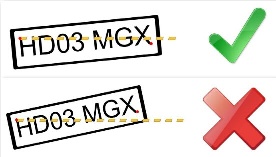 Image Removed
 - blurry (due to incorrect shutter speed setting that does not match the vehicle speed);
Image Removed - distorted (due to incorrect camera position);
Image Removed - interlaced;
Image Removed - dirty.
Image Removed
| Note |
|---|
|
Any deviation from the above requirements reduces the probability of correct license plate recognition. |
An example of license plate images that will be recognized correctly and completely:
Image Removed
Recommendations for highways
...
:  Image Added Image Added
|
|
...