
Go to documentation repository


Page History
| Section | |||||||||||||||||||||
|---|---|---|---|---|---|---|---|---|---|---|---|---|---|---|---|---|---|---|---|---|---|
|
General information about configuring Automatic connection
This setting is used to automatically connect:
- the client to the server without re-entering the server name, username and password when starting the app;
- the client to servers belonging to different domains (see Cross-System client);
- the client to the nodes of the failover system (see Configuring Failover VMS).
If you connect automatically, the servers
It is possible for the Client to automatically connect to Servers on different Axxon domains—Cross-System Client.
For this to take place, the following conditions must be true:
- Professional, Enterprise or Unified license has been activated on each Server to which the Client is connected (see Axxon One license types). For example, some of the Servers may have an Enterprise license activated, and some may have a Unified one;
- connection to all Servers made via with the same user name/password combination on each Axxon domain;
Server names and IP addresses are unique.
...
| title | Note |
|---|
...
specified in the Automatic connection parameters group
...
are used first. If these
...
servers are unavailable, the system
...
tries to connect to
...
the servers from the Preferred servers parameters group
...
following the set order (see Selecting Preferred Servers).
...
Configuring the automatic connection
To configure the automatic connection, do the following:
- Select the Options tab (1) → Automatic connection (
Configuration of automatic connection to Servers on different Axxon domains is performed as follows:
- Go to Settings → Options → Automatic connection (1-2).
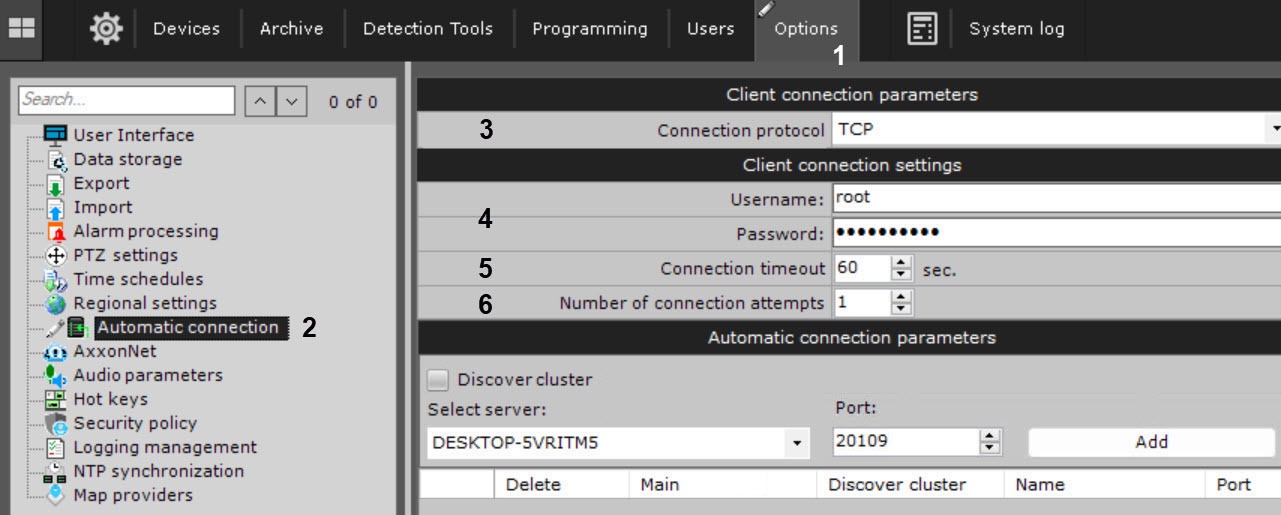
Configuring the protocol used by Clients to connect to the Server allows prioritizing reliability or speed of data transmission (3). The connection protocol is set individually for each Server in an Axxon domain. All Clients connected to the Server will receive video streams over the selected protocol.
Descriptions and recommendations for selecting a protocol From the drop-down list (3), select the server connection protocol.
Description of the protocol and recommendations for selection are given in the table.
bandwidth-intensive. Recommended for Servers with small numbersProtocol Description TCP This protocol is more reliable but
is typically faster but less reliable for data transmission. Unicast involves data transmission to a single recipient.has a busy connection. We recommend selecting it for servers with a small number of cameras UDP unicast The UDP protocol has a higher data transmission speed, but it is less reliable. The unicast scheme is used to transmit data to one recipient. You must select this protocol for a server with a large number of cameras that has several clients working with it UDP multicast The multicast scheme is used to transmit data
This protocol is best for Servers with many cameras connected to a single Client.
UDP multicast Multicast refers to data transmission
designedto a group of recipients. This protocol is
Servers with many cameras connected to multiple Clients.best suited for
Important! This protocol has to be supported by all network components, in particular, switches.
a server with a large number of cameras that has many clients working with it.
Attention! To operate with this protocol, all network elements, including switches must support itThe connection protocol determines whether you prioritize connection reliability or data transmission speed. You can select the connection protocol on the client side for each server individually. The client will receive video streams via the protocol specified in its connection settings.
- For automatic authorization when connecting to servers, enter the username and password Type the user name and password needed for logging in to each Axxon domain (4). If you leave these fields emptyblank, manual authorization will be required when the Client starts.authorization is performed manually when you start the client.
Note title Attention! The Cross-System client connects to all servers using a single username-password pair that must be created in each domain (see Cross-System client).
- In the Connection timeout field (5), specify the waiting period Specify the Connection timeout parameter (5), which determines how long one must wait for a successful connection before considering the attempt to be unsuccessful. The default timeout value is 60 seconds, the maximum value is 300 seconds (5 minutes). When using If you use this setting, an automatic connection will attempt to connect occurs immediately. If the connection fails, the Server server will wait for a user-specified period of time the time period (timeout) specified by the user and retry repeat the connection attempt.
- Specify the maximum number of automatic connection attempts after the specified timeout (6).
- Indicate the Servers Specify the servers to which you want to connect to. For each Serverserver, perform do the following steps:
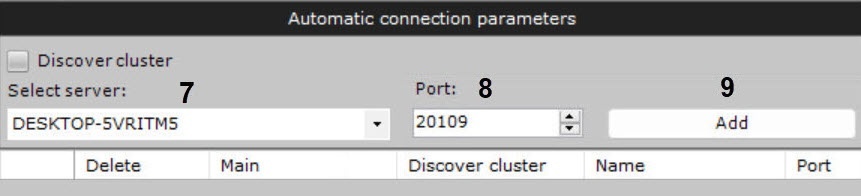
- Select a server from the list or enter the server IP address
- select the Server in the list (7);.
- indicate Specify the port for connecting to the Server server (8).
Info title Note If you leave the Port field is left blank, the standard port (20111) will be 20109 is used for connectingconnection.
- Click the Add button (9).
Info title Note title NoteIt is possible to - If you use the Cross-System client, you can connect to only one
- server of each domain (see Cross-System client). That is why when you add a server to the list, all other
- servers of this domain become unavailable for selection.
Info - To remove a
- server from the list, click
button.
When connecting, the Client- the
 button.
- the
Configuration of automatic connection of the client to servers is complete. The next time you start Axxon One, the system connects to the selected servers.
Configuration of automatic connection of the client to servers belonging to different domains
When you use the Cross-System client, select the main domain after you add all servers to the list. To select the main domain, set the Main checkbox in the corresponding column of the server that belongs to this domain.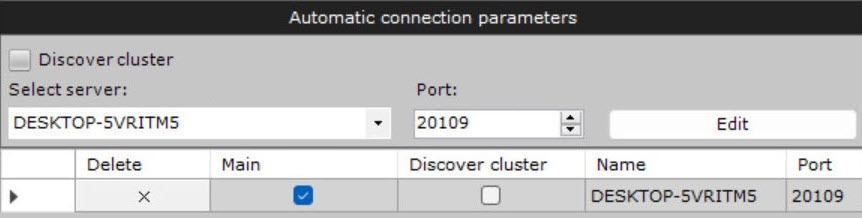
When you connect, the client will use the parameters (maps, layouts, user
...
permissions) of the main
...
domain.
...
Configuration of automatic connection of the client to the nodes of the failover system
If you want to configure the automatic connection to a node of the failover system:
- Set the Discover cluster checkbox (1).

- Enter the IP address of any server of the cluster (2) and click the
 button.
 - From the drop-down list (3), select a node that you want to add to autoloading.
- Click the Add button.
- Click the Apply
 button.
Configuration of automatic connection of the client to the node of the failover system is complete.
Configuration of automatic connection to the backup server
To automatically connect to the backup server if the main server in the N+1 cluster configuration is unavailable:
- In the Automatic connection parameters group, enter the IP address and port of the main server, as well as the name of the node.
- Click the Add
 button.
 - Set the checkboxes in the Main and Discover cluster columns.
- In the Preferred servers parameters group, select a backup server from the list or enter its IP address and node name.
- If necessary, change the default port for the backup server in the Port field.
- Click the Add button.
- Click the Apply button.
Configuration of automatic connection with the backup server is complete.
Change the server port
To change the port of the already added server:
- Select the server from the list again (1).
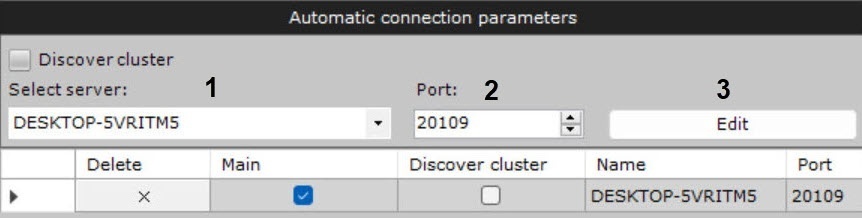
- In the Port field (2), specify a new number.
- Click the Edit button (3).
Changing the port of the added server is complete.
Export and import of the configuration of automatic connection
To save the configuration of the automatic connection to servers and preferred servers (see Selecting Preferred Servers) to a JSON file, click the Export button.

To load the configuration on the clients, do the following:
- Click the Import button.
- Click the Apply button.
Click Export (1) to save the automatic Server connection and Preferred Servers (see Selecting Preferred Servers) configuration to the JSON file.

To load the preset configuration to other Clients, do the following:
- Click Import (2).
- Click Apply.
To change a port on an added Server, do the following:
- Select this Server again from the list (1).

- Enter a new port (2).
- Click Edit (3).
Auto-connection to Servers on different Axxon domains is now complete.
The next time Axxon One is started, connection to the selected Servers with the specified user credentials will occur automatically.
If the Client is connected to several Servers, the Server settings are reproduced for each Server (see Server settings).
...
Overview
Content Tools