
Go to documentation repository


Page History
...
The settings panel of the Operator protocol interface object is shown in the figures. Tables below describe the setting parameters corresponding of the Operator protocol object.
The Filters tab

№ | Parameter | Method for setting the parameter value | Parameter description | Representation | Default value | Value range |
1 | The Identification number* field | Automatically | Displays the identification number of the Operator protocol object in the system |
Digits, letters, periods, hyphen, dash, and underscore | NA | Depends on the number of the Operator protocol objects in the system | ||
2 | The Name* field | Enter the value in the field | Sets the name of the Operator protocol object in the system | Latin alphabet, Cyrillic, |
digits, and service characters | Operator protocol | A line containing a sequence of any characters (letters, digits, service characters except > and < characters), case-insensitive. Number of characters—from 1 to 60 | ||||
3 | The Disable checkbox | Set the checkbox | Disables the Operator protocol object in the system | Boolean type | Clear | Set—the Operator protocol object is disabled and isn't used Clear—the Operator protocol object is enabled and used |
4 | The Display drop-down list | Select the value from the list | Sets the Display parent object for the given Operator protocol object |
Names of the Display objects registered in the system |
Name of the Display parent object | Depends on the number of the Display objects in the system | |||||
| The Position group | ||||||
5 | The X field | Enter the value in the field | Sets the X coordinate in the horizontal axis for the upper left corner of the Operator protocol window | % of the screen width | 50 | From 0 to M*100, where M is the number of the installed monitors |
The Y field | Enter the value in the field | Sets the Y coordinate in the vertical axis for the upper left corner of the Operator protocol window | % of the screen height | 50 | From 0 to M*100, where M is the number of the installed monitors | |
6 | The W field | Enter the value in the field | Sets the width of the Operator protocol window | % of the screen width | 50 | From 0 to M*100, where M is the number of the installed monitors |
The H field | Enter the value in the field | Sets the height of the Operator protocol window | % of the screen | |||
width | 50 | From 0 to M*100, where M is the number of the installed monitors | |
7 | The Allow moving checkbox | Set the checkbox | Allows moving the Operator protocol window |
using the mouse | Boolean type | Clear | Set—allow moving the Operator |
protocol window using the mouse Clear—disable moving the Operator |
protocol window using the mouse |
| 8 |
The | Click the button | Opens |

the window to set the position of the Operator protocol window using the mouse | NA | NA | NA |
| 9 | The Monitor drop-down list | Select the value from the list |
| Determines the number of the monitor in the system for which the coordinates are specified | Numbers of the monitors in OS | 1 | From 1 to 16 | |||
| The Filters tab | ||||||
| 10 | The Add events button | Click the button | Opens the window for bulk adding the events from an object of the selected type | NA | NA | NA |
| The | ||||||
| Objectstable | ||||||
11 | The Type drop-down list | Select the value from the list | Sets the type of objects, the events from which must be displayed in the Operator protocol window | Available object types | NA | Depends on the objects registered in the system. Only the objects for which the "INFORMATION" or "ALARM" value is selected in the Messages processing column on the Events tab in the ddi.exe utility are available for selection (see The Events tab) |
12 | The Number drop-down list | Select the value from the list | Sets the number of | |||
the object, which events must be displayed in the Operator protocol window | Sequence of numbers | NA | Depends on the number of the objects of the specified type registered in the system |
13 | The Name field | Automatically | Sets the name of |
the object, which events must be displayed in the Operator protocol window | Names of the |
objects registered in the system | NA | Depends on the objects |
registered in the system | |||
14 | The Event type drop-down list | Select the value from the list | Sets the events displayed in the Operator protocol |
window | Events available for the selected object | NA | Depends on the object type |
15 | The Request password drop-down list | Select the value from the list |
Determines the necessity of a password to process the event | Boolean type | NA | Set—password confirmation is required to process the event Clear—password confirmation isn't required to process the event | |||
16 | The Region drop-down list | Select the value from the list | Sets the Region object corresponding to the monitored object | List of the Region objects created in the system | NA | Depends on the number of the Region objects created in the system |
17 | The Parameter field | Enter the value in the field | Sets the parameter of the monitored object | Depends on the event type | NA | Depends on the event type |
| 18 | The Value field | Enter the value in the field | Sets the parameter value |
| of the monitored object | Depends on the event type | NA | Depends on the event type |
| 19 | The Help file field | Enter the value in the field | Sets the full path to the text file in |
| PDF, |
| DOC, |
| DOCX, |
| TXT which contains the help guide about the event processing | File address in the file system | NA |
| In accordance with the file system limitations | |||
| 20 | The Priority drop-down list | Select the value from the list | Sets the event priority |
| when sorting by importance | Sequence of numbers | NA | From 1 to 10. The lower the value, the higher the priority | |||
| The Parameters table | ||||||
| 21 | The Parameter field | Enter the value in the field | Sets the name of the parameter, the value of which must be displayed in the Operator protocol | |||
window | Latin alphabet, Cyrillic, |
| digits, and service characters | NA | Depends on the parameters sent by the event | ||
22 | The Description field | Enter the value in the field | Enters a short description of the specified parameter | Latin alphabet, Cyrillic, |
digits, and service characters | NA | From 0 to 255 characters |
| The Checklist table | ||||||
| 23 | The Description field | Enter the value in the field | Sets the description of the action that the operator must perform before assigning a status to the event | Latin alphabet, Cyrillic, | ||
| digits, and service characters | NA | From 0 to 255 characters | ||||
| Out of the group | ||||||
| 24 | The Chief interfaces checkbox | Set the checkbox | Sets the Operator protocol object, to which the events must be sent after the time specified | |||
by the Wait for operator response for |
parameter | List of the |
| available Operator protocol objects in the system | NA | Depends on the number of |
| the Operator protocol |
| objects created in the system | |||
| 25 | The Map drop-down list | Select the value from the list | Sets |
| the Map |
| object used to display the monitored object | List of the |
| available Map |
| objects in the system | NA | Depends on the number of the Map objects created in the system | |
| 26 | The Video drop-down list | Select the value from the list | Sets the method of the archive and live video display |
| by the event in the |
| operator protocol | Available display methods | ActiveX | ActiveX—archive |
opens in a separate window Monitor—archive will open |
in the selected |
video surveillance monitor | |||||
| 27 | The Wait for operator response ____ minutes field | Enter the value in the field | Sets the time after which the event is assigned the Non-processed event type or the event is escalated | Min | 2. |
| 5 | From 0 to 10000. Fractional values can be specified; integer and fractional parts are point-separated. For example, to set 2 minutes 30 seconds time period, enter 2. |
5 | ||||||
| 28 | The Store ____ events field | Enter the value in the field | Enters the maximum number of events that can be displayed simultaneously in the list of the current events | Integer numbers | 100 | Any integer starting from 0 |
| 29 | The Delay decision making for ____ minutes field | Enter the value in the field | Sets the time for which the operator can delay the event processing | Min | NA | From 0 to 600.
|
|
The Functions group*
| 30 | The Sort by priority checkbox | Set the checkbox | Enables the sorting of events by priority. The descending sorting |
:
|
The last three event parameters can be set in the DDI file—see The Events tab |
| Boolean type | Set | Set—sorting by priority is enabled Clear—sorting by |
order the events are received is enabled | ||||||
| 31 | The New events at the end checkbox | Set the checkbox | Places new events at the end of the current events list | Boolean type | Clear | Set—new event is placed at the end of the list Clear—new event is |
added at the beginning of the list | |||
| 32 | The Close elsewhere checkbox | Set the checkbox | Deletes the event from other |
| operator protocols when it is processed in one of the |
| operator protocols | Boolean type | Clear | Set—when the event is processed in one of the |
operator protocols, it is deleted from other |
operator protocols Clear |
—after the event is processed |
, it stays unprocessed in other |
operator protocols | |
| 33 | The Password for closing |
| checkbox | Set the checkbox |
Determines the necessity to enter the password to process the event | Boolean type | Clear | Set—the event processing must be confirmed with a password Clear—password isn't required for event processing |
34 | The Autoswitch checkbox | Set the checkbox | Enables autoswitch to the Current events tab |
of the Operator protocol window when a new event occurs | Boolean type | Clear | Set—autoswitch is enabled Clear— |
autoswitch is disabled | ||||||
| 35 | The Autoactivation of last event checkbox | Set the checkbox | Enables the automatic cell activation of the last received event | Boolean type | Clear | Set—the cell of the last received event is automatically activated Clear—when the event is received, the cell selected by the |
operator remains active | ||||||
| 36 | The Hide buttons for groups checkbox | Set the checkbox | Hides the event processing buttons when a group of events is selected | Boolean type | Clear | Set—the event processing buttons are displayed when a group of events is selected Clear—the event processing buttons are hidden when a group of events is selected |
| 37 | The Clear comment checkbox | Set the checkbox | Clears the comment field after the event is processed by the |
| operator | Boolean type | Clear | Set—the comment field is automatically cleared after the event is processed by the |
operator Clear—the comment text remains in the comment field after the event is processed by the |
operator | |
| 38 | The Fit window size |
| checkbox | Set the checkbox | Enables the automatic resizing of the cell according to the Operator protocol window | Boolean type | Clear | Set—the cell size is set equal to the size of the Operator protocol window area, that isn't occupied by the event control panel Clear—the cell size is set according to the content size | |
| 39 | The Hide "Apply to all" checkbox | Set the checkbox | Disables the Apply to all button | Boolean type | Clear | Set—the Apply to all button is unavailable in |
the Operator protocol window, and the |
operator cannot process all events at once Clear—the Apply to all button is available | |||
| 40 | The Over all windows checkbox | Set the checkbox | Enables the Operator protocol to be displayed |
| over all windows | Boolean type | Clear | Set—the Operator protocol window is displayed |
over all windows Clear—the Operator protocol window is displayed in the standard mode | |
| 41 | The Comment required |
| checkbox | Set the checkbox | Prevents event processing without entering a comment | Boolean type | Clear | Set—the buttons for classifying the events ( |
alarm situation, |
suspicious situation, |
false alarm) don't appear until the Comment field is filled Clear—the |
operator can classify (process) the event without entering a comment | |||
| 42 | The Single selection checkbox | Set the checkbox | Prevents the |
operator from selecting multiple events using the Shift and Ctrl keys | Boolean type | Clear | Set—the |
operator cannot select multiple events using the Shift and Ctrl keys Clear—the |
operator can select multiple events using the Shift and Ctrl keys |
The DB tab
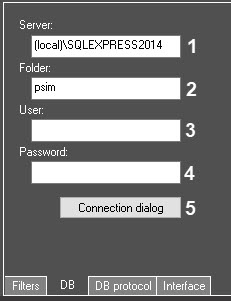
| № | Parameter | Method for setting the parameter value | Parameter description | Representation | Default value | Value range |
1 | The Server |
field | Enter the value in the field | Sets the name of the database server, in which the required database is stored | Latin alphabet, Cyrillic, |
digits, and service characters | Name of the server used by the system | Depends on the number of servers in the system |
2 |
The Folder | Enter the value in the field | Sets the name of the database, in which the events must be stored | Latin alphabet, Cyrillic, |
digits, and service characters | Name of the main database used by the system | Depends on the number of databases used by the system | ||
3 | The User field | Enter the value in the field | Sets the username for authorization in the database server | Latin alphabet, Cyrillic, |
digits, and service characters | NA | NA | ||
4 | The Password | Enter the value in the field | Sets the password for authorization in the database server | Latin alphabet, Cyrillic, |
digits, and service characters | NA | NA |
5 | The Connection dialog |
| Click the button | Opens the window of the database server connection | NA | NA | NA |
TheDB protocol tab
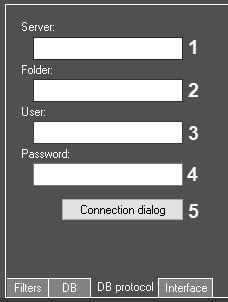
| № | Parameter | Method for setting the parameter value | Parameter description | Representation | Default value | Value range |
1 | The Server |
field | Enter the value in the field | Sets the name of the database server, in which the required |
event viewer database is stored (if it is extracted to a separate DB) | Latin alphabet, Cyrillic, |
digits, and service characters | Name of the server used by the |
event viewer database (if it is extracted to a separate DB) | Depends on the number of servers in the system |
2 |
The Folder field | Enter the value in the field | Sets the name of the |
event viewer database (if it is extracted to a separate DB), in which the events must be stored | Latin alphabet, Cyrillic, |
digits, and service characters | Name of the |
event viewer database (if it is extracted to a separate DB) used by the system | Depends on the number of the event viewer databases used by the system | ||
3 | The User field | Enter the value in the field | Sets the username for authorization in the |
event viewer database server (if it is extracted to a separate DB) | Latin alphabet, Cyrillic, |
digits, and service characters | NA | NA | |
4 | The Password | Enter the value in the field | Sets the password for authorization in the |
event viewer database server (if it is extracted to a separate DB) | Latin alphabet, Cyrillic, |
digits, and service characters | NA | NA | |
5 | The Connection dialog | Click the button | Opens the window of |
event viewer database server connection (if it is extracted to a separate DB) | NA | NA | NA |
The Interface tabInterface tab

| № | Parameter | Method for setting the parameter value | Parameter description | Representation | Default value | Value range |
| 1 | The Frame drop-down list | Select the value from the list | Sets the frame color of the active cell | Color palette | Black | RGB color |
| The Situation buttons |
| group | ||||||
| 2 | The Alarm field | Enter the value in the field | Sets the name for the | |||
| alarm assessing button | Latin alphabet, Cyrillic, |
| digits, and service characters | NA | From 0 to 255 characters |
| The Suspicious field | Enter the value in the field | Sets the name for the |
| suspicious assessing button | Latin alphabet, Cyrillic, |
| digits, and service characters | NA | From 0 to 255 characters |
| The False field | Enter the value in the field | Sets the name for the |
| false assessing button | Latin alphabet, Cyrillic, |
| digits, and service characters | NA | From 0 to 255 characters | ||
| 3 | The Keyboard shortcut* field | Press the key combination | Sets the key shortcuts for the events assessment | Keyboard combinations |
| None |
| |||||
| Out of the group | ||||||
| 4 | The View drop-down list | Select the value from the list | Sets the option of displaying events on the Current events tab | Available display options | operator |
|
|
| ||||||
| 5 | The Group by drop-down list | Select the value from the list | Sets the option of grouping events on the Current events tab | Available grouping options | operator |
|
|
|
*Name of the element isn't displayed in the settings panel of the given object.
Overview
Content Tools