The - You can configure the Fire detection
module can be configured - module on the settings panel of
the - the Fire detection object created on the basis of the Camera object on the Hardware tab of the
System - System settings
dialog - window.
The - You can configure the Smoke detection
module can be configured - module on the settings panel of
the - the Smoke detection object created on the basis of the Camera object on the Hardware tab of the
System - System settings
dialog - window.
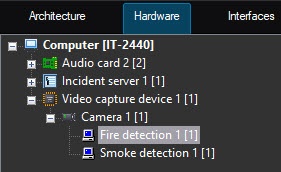 Image Modified
The To configure the Fire detection and Smoke detection modules are configured similarly and as follows modules, do the following:
- Go to the settings panel of the
appropriate - corresponding module.
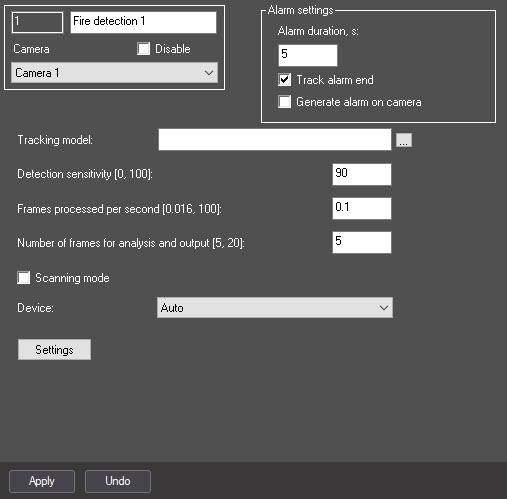 Image Modified
 In the Minimum alarm time, s - To receive events about the end of fire/smoke only after the time period from the Alarm duration, sec setting, set the Track alarm end checkbox. By default, the checkbox is cleared, which means that events about the end of fire/smoke are received immediately.
- In the Alarm duration, sec field, enter the time period in seconds during which the repeated fire/smoke
alarms will be ignored Image Removed
Set the Track alarm end checkbox, if it is necessary to generate an end-of-alarm event only after the expiration of the time, which is counted as: time of the last received alarm + time specified in the Minimum alarm time, s parameter- alarm events are ignored. By default, the setting isn't available for editing. To enable it, you must set the Track alarm end checkbox (see the previous step).
For example, if 5 seconds is set in the Minimum alarm time, sfield, and there is a fire/smoke on the image during a longer period of time, then in order to avoid receiving messages about the fire/smoke from the detection tool every 5 seconds, set a higher value for the Minimum alarm time, s parameter (for example, 10 seconds). In this case, only one message about the fire/smoke will be displayed, and all the following alarms will not be displayed in the Event viewer until the time interval between the recognitions of the fire/smoke becomes longer than 10 seconds.If you set the Track alarm end checkbox, the events about the end of fire/smoke are received after the time specified in the Alarm duration, sec setting. If, until the end of this period, the current fire/smoke is completed and the new one is detected, the detector doesn't generate events about completing the current and starting the new alarm. The new fire/smoke event is received after the current alarm is completed. |
- Set the Generate alarm on camera checkbox
, - if
it is necessary - you want to initiate an alarm on the camera when
a detection tool is triggered.- the detector generates an event.
- By default, the standard (default) neural network is initialized according to the device selected in step 10. You must not select the standard neural networks for the different processor types manually, since it is performed automatically. If there is
If - a unique neural network
is prepared - for use,
in the- click the
 Image Added button to the right of the Tracking model field,
 click the Image Removed button, - and
select the - specify its file in the standard Windows Explorer window that opens
. If the field is left blank, the default neural networks will be used for detection (see the table below)- .
They are selected automatically depending on the CPU and are located in the C:\Program Files (x86)\Axxon PSIM\Modules64 directory:| Neural network name | Detection/CPU |
|---|
| smoke_openvino.ann | Smoke detection/CPU |
| smoke_original.ann | Smoke detection/GPU |
| fire_openvino.ann | Fire detection/CPU |
fire_original.ann | Fire detection/GPU Image Removed
In the Detection sensitivity [0, 100] field, enter the detector sensitivity
—an integer value in the range from 0 to 100. This parameter determines at what certainty of fire/smoke detection the
detector generates an alarm: the higher the sensitivity, the higher the recognition threshold. For example, at sensitivity 100, the
detector neural network must get 100% certainty for some period of time
during the frame processing
. The value of the Detection sensitivity field is determined experimentally.
- In the Frames processed per second [0.016, 100] field, set the number of frames per second that
will be processed by - the neural network processes. This value
has an impact on - affects the processor load: the higher the value, the greater the load. It also
has an impact on - affects the
algorithm - operation speed of the algorithm: the higher the frame rate, the faster the required number of frames
will be - are collected for making a decision and
triggering - generating an alarm, if required.
In the Number of frames for analysis and output [5, 20] field, enter the minimum number of frames in the range from 5
to 20 for the
detector to analyze before
generating an alarm. The higher the value, the more reliable the result of the
detector operation. At the same time, if the value is too high, the short-time fire/smoke can be missed. If you enter a value less than the minimum, the value is set to 5
| Info |
|---|
|
Multiplication of Minimum alarm time, s and Number of frames for analysis and output values is the time period (in seconds) after which the alarm will trigger after the fire/smoke detection.
Set
the Scanning mode checkbox to track small objects. If you enable this mode, the load on the system
increases. That is why we recommend
setting the small number of frames processed per second
in step 7. By default, the checkbox is
cleared. For more information on the scanning mode, see Configuring the Scanning mode.
| Info |
|---|
|
You cannot configure the scanning windows for the Fire detection and Smoke detection modules. The default parameters are used. When you use the scanning mode, we recommend using a full frame without specifying the area of interest in step 11. |
- From the Device drop-down list, select the device on which the neural network will operate: the CPU, one of the NVIDIA GPUs, or one of the Intel GPUs. Auto
—- (default value)—the device is selected automatically: The NVIDIA GPU gets the highest priority, followed by the Intel GPU, then the CPU.
 Image Removed button. The Detection settings windows will open
- Specify the area of interest on the video image:
- Click the Stop video button to capture the frame of the video image.
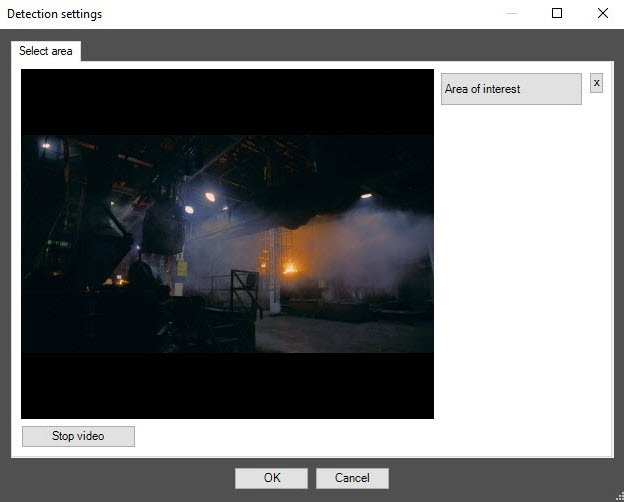 Image Modified
 - Click the Area of interest button.
On the captured video
imageframe, sequentially set the anchor points of the area using the left mouse button, the situation
of which you want to analyze
. After you add the area, the remaining part of the video image
is darkened. If you don't specify the area of interest, the entire frame is analyzed.
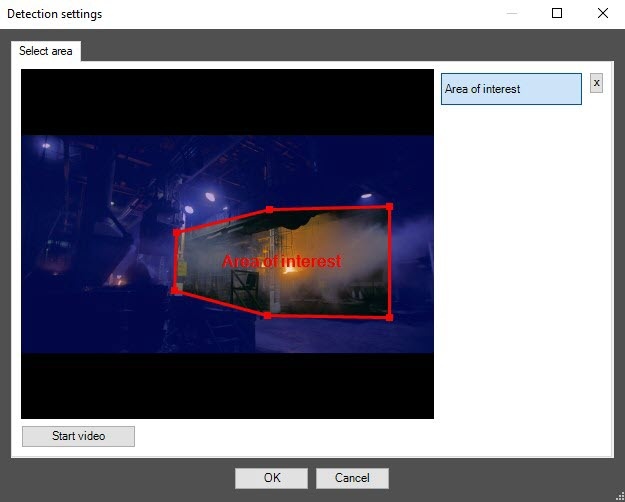 Image Modified
Click the OK button.
|
To remove the area, click the  Image Modified button next to the Area of interest button. Image Modified button next to the Area of interest button. You can add only one area. If you try to add the second area, the first area is deleted. |
- Click the Apply
 Image Removed button
- button.
Configuring the Fire detection and Smoke detection modules is complete.
...