
Go to documentation repository


Page History
| Section | |||||||||||||||||||||
|---|---|---|---|---|---|---|---|---|---|---|---|---|---|---|---|---|---|---|---|---|---|
|
General information
You can add video cameras and IP Servers devices to the system by using the IP Device Discovery Wizard.
To open the IP Device Discovery Wizard, click the Add device ... link link at the end of the Server server device list.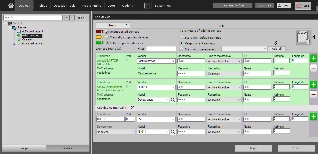
When the Wizard is opened for the first time after the Client is started, automatic search for new devices will begin. During subsequent sessions, to launch the Wizard you must click the corresponding button. A progress bar indicates search progress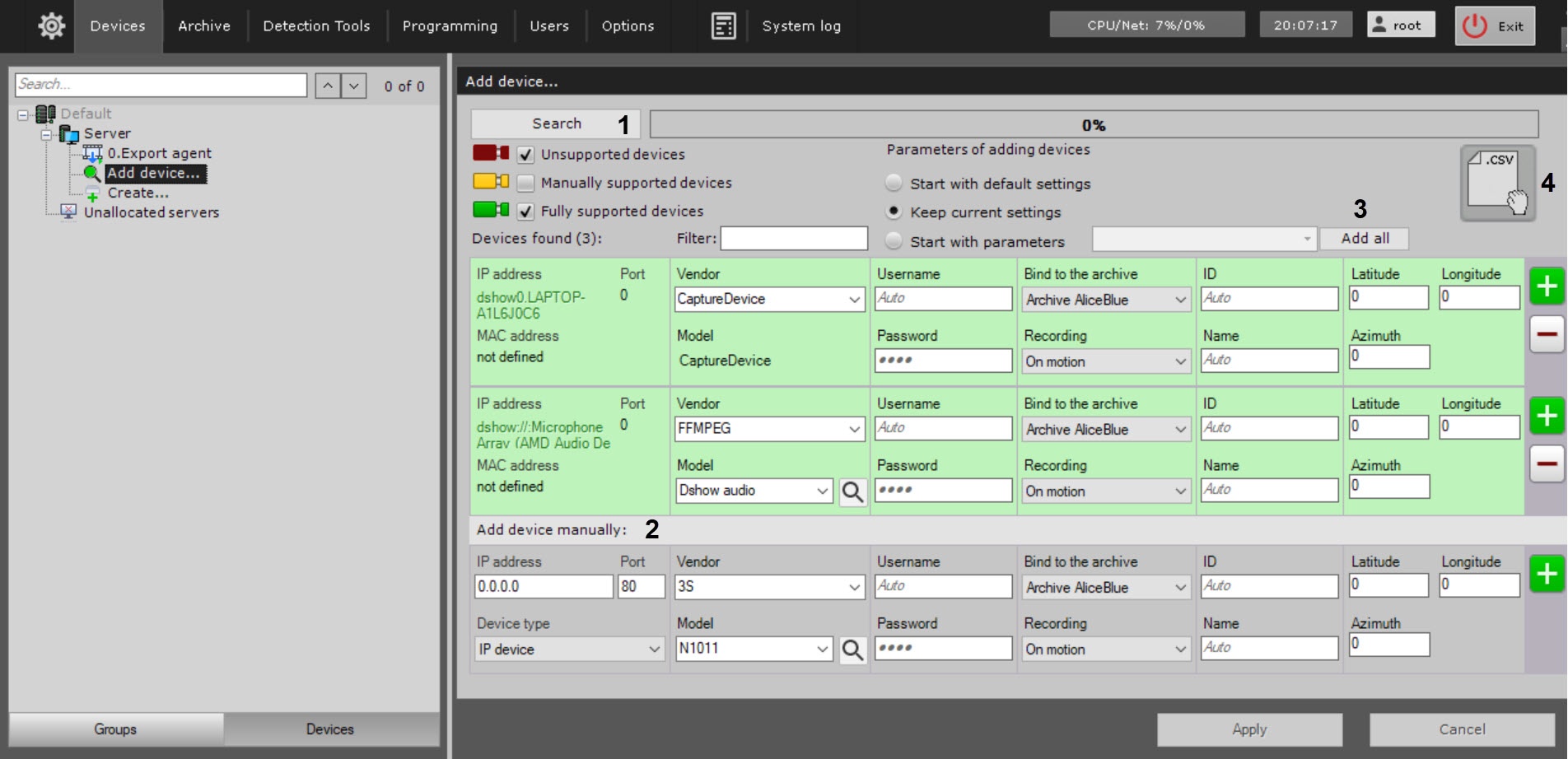
The IP Device Discovery Wizard interface includes:
- Automatic device search.
- Manual entry of device data.
- Adding devices to the configuration.
- Bulk adding devices using .CSV files (see Bulk creation of IP devices).
Automatic search for IP devices
IP devices search
To start searching for devices, click the Search button. While searching, a progress bar is displayed.

To stop devices device search at any time, click the Stop button.
| Info | ||
|---|---|---|
| ||
Since multicast packets are used for device search, the search results may not contain the Servers and devices from other subnets. |
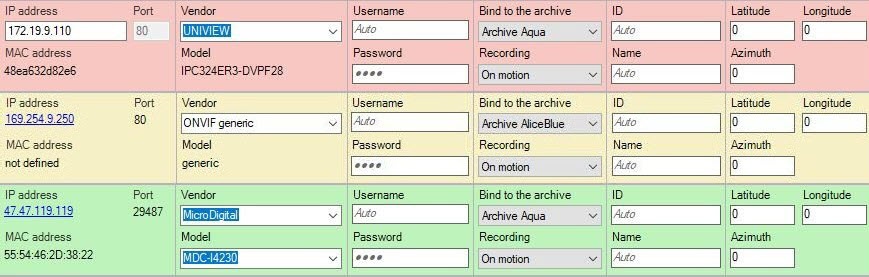
The search results are color-coded based marked by different colors depending on the status of the found device.
Color of video camera icon
Axxon One compatibility not
Camera color | Description |
|---|---|
| Fully supported device |
| Manual configuration required |
|


| Device operation in Axxon One isn't guaranteed |
| Info | ||
|---|---|---|
| ||
|
Filtering IP device search results
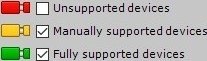
Search results can be filtered in two ways:
- By status. To hide devices with a certain status in the search results, deselect the relevant checkboxcorresponding checkboxes.
- By manufacturervendor, model or , and IP address. To do this, use the Filter field. For example, this filters filter shows the search results of the Sony devices device.
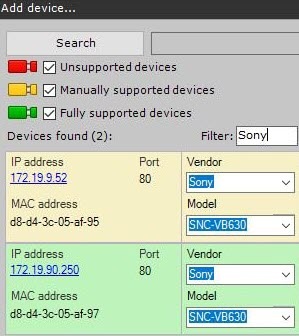
In additionWith a filter, you can filter search for cameras from in a certain subnet.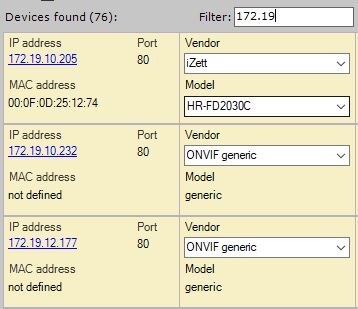
When adding a device, you can immediately set several configuration options, such as:
Manufacturer and model.
| Info | ||
|---|---|---|
| ||
You can search by manufacturer and model of the device. |
...
ID and object name.
| Info | ||
|---|---|---|
| ||
An object identifier must contain: numbers, English characters and the "_" sign. In the Object Tree, added devices will be sorted by ID. |
...
Manual input of device data
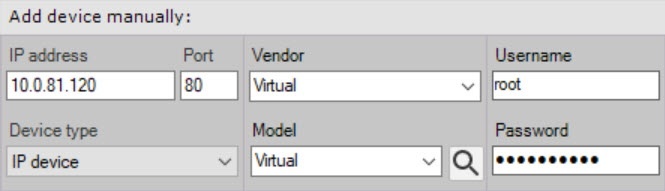
If the IP device is absent in the automatic search results (it is located on a different subnet or the connection with it is temporarily lost), you can add it manually. To do this, you need to select the type of the added IP device, specify the IP address and connection port of the device, and select the vendor and model in the area with a neutral background located under the list with automatic search results.
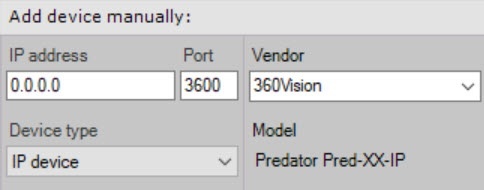
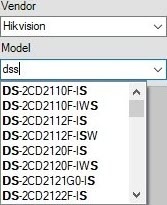
You can also specify the vendor and model of the device by using the search in the input field.
If the IP address, Port, Vendor, Username and Password are set for a device, the device model can be automatically detected by clicking the  button.
Adding devices to the configuration
The algorithm of adding the IP device to the configuration is the following:
- select a mode for adding a device to the configuration;
- specify the device settings, if necessary;
- add a device to the configuration.
Modes for adding devices to the configuration
There are three modes of adding a device to the configuration. Their description is given in the table.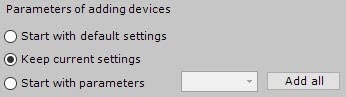
On motion/Embedded detection – an embedded VMD tool and an automatic rule for writing to the specified archive are automatically created for the camera you are adding. By default, recording stops when an event detection is finished.
| Info | ||
|---|---|---|
| ||
This option is available only for devices that have on-board VMD. |
| Info | ||
|---|---|---|
| ||
When creating a new device, the pre-alarm time interval for video footage recording is automatically set to 3 seconds (see Configuring recording to an archive). |
...
In addition, three modes are available for adding a device to a configuration. These are described in the following table.
Device addition mode | Description | |
|---|---|---|
| 1 |
Keep current settings | The IP device is added to the configuration with the |
| current settings that are specified in the web interface | |
| 2 | Start with default |
| settings | The IP device is added to the configuration with the settings that are determined as default in Axxon One. When you add a device in this mode, it changes the current device settings |
specified in the web interface |
| 3 |
| Start with |
| parameters | The IP device is added to the configuration with the settings that have been previously specified for a device of the same model in the configuration. |
The template device |
from the corresponding list is selected. |
The following settings will be copied from the template device to the new, similar device
when you select a template. |
the Other |
settings (see |
), and |
the Other |
settings for |
Microphone |
and |
Speaker |
objects, if these are configured for the template device. |
cameras of the same model are |
used at a site. |
In this |
case, |
the algorithm of adding a device to the configuration is the following: |
|
To add an IP device to a configuration:
- Set device settings, if necessary.
- Select a mode for adding the device to the configuration.
- The device is then added to the configuration.
|
Configuring IP device settings
When you add a device to the configurations, you can immediately set several parameters, such as:
vendor and model,
- login and connection password,
ID and object name,
Info title Note - The object ID can contain numbers, Latin letters, and the "_" sign. Once the device is created, its short name will match the specified ID (see Camera). In this case:
- The camera ID cannot be changed, since it is used to maintain the connection with the archive if you replace the camera (see Saving the archive when replacing the video signal device).
- The short name can be changed, and the added devices will be sorted in the object tree in ascending order of this field (see Camera).
- The object ID can contain numbers, Latin letters, and the "_" sign. Once the device is created, its short name will match the specified ID (see Camera). In this case:
- select an archive and set the recording parameters (see Configuring recording to an archive):
- No—camera is linked to the archive, no recording;
- Always—continuous recording;
- On motion (selected by default)—either the embedded motion detector (see General information about embedded detectors) or the Axxon One motion detector (see Configuring the Motion detector) will be automatically created for the added camera. Also, the automatic rule for recording to the specified archive (see Automatic rules) will be created. By default, recording stops when an event from the detector is no longer generated.
Info title Note - When you create a device, the pre-alarm time interval for archive recording is automatically set to 3 seconds (see Configuring recording to an archive).
- The embedded motion detector is created automatically only for certain camera models. The information about the support for the embedded motion detector is given in the list of supported devices in the Analytics column. The embedded motion detector is configured through the web interface of a specific camera. In other cases, the Axxon One motion detectoris created.
- device location coordinates in the 53.212558; 50.204991 format (coordinates are used when you add a camera to the map, see Adding video cameras).
Adding devices
During one operation, you can add one device or all devices from the search results to the configuration (except those for which operation isn't During a single configuration change, you can add a single device or all devices listed in the search results (other than devices for which compatibility is not guaranteed). To add one device, click the 
 button. To add all devices, click the Add all button.If you set no individual access parameters while adding hardware, a dialog window appears for setting unified access parameters.
...
| title | Note |
|---|
...
button.
| Info | ||
|---|---|---|
| ||
Remember Keep in mind that if when you add all IP devices at the asme time, the same addition mode and settings will be applied to used for all of them. |
If an IP device is not shown in To remove a device from the search results (because it is located on another subnet or contact has been temporarily lost), you can add it manually. To do so, in the neutral-colored area above the search results, select the type of IP device that you are adding (with or without edge storage), specify an IP address and port, and select the manufacturer and model.
Then add the device to the configuration by following the steps described previously., click the  button.
If you don't set access parameters to the devices while adding them, the window for setting the unified access parameters will be displayed. 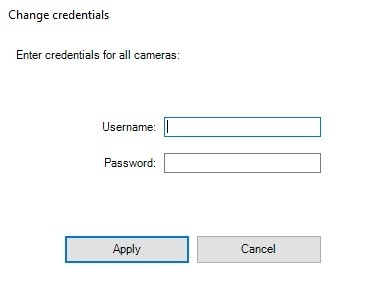
Next, a device is added to the configuration.
When you add a device to the system, the Default permissions are applied, which are configured for each role (see General information about users).
Removing IP devices
To remove IP devices, select them one or more objects in the device list (tree by left-clicking one or more devices, (while holding down the CTRL Ctrl key to select multiple devices) and click the Delete button.If you click the IP address, you will jump to the device Web interface.
Overview
Content Tools