
Go to documentation repository


Page History
| Section | |||||||||||||||||||||
|---|---|---|---|---|---|---|---|---|---|---|---|---|---|---|---|---|---|---|---|---|---|
|
| Tip |
|---|
General information
A remote archive can only be represented as a file on one or several remote storages.
The following protocols of remote storages are supported:
- For Linux OS:
- SMB2/SMB3.
- NFSv3/NFSv4.
- CIFS.
- iSCSI.
- For Windows OS:
- WinAPI access mechanism (current version for Windows 10 and 11).
The choice of protocol depends on the configuration, security policies, and capabilities of the NAS.
Create a remote archive
To create a remote archive, do the following::
- Go to the Archive tab.
- In the branch of the
- the Server object, click
- click the Create... link.
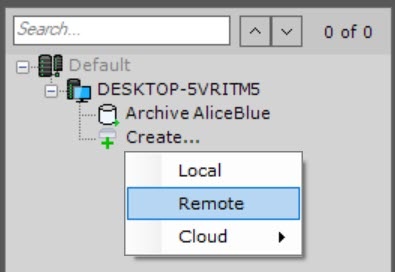
- Select the Remote archive
- archive type.
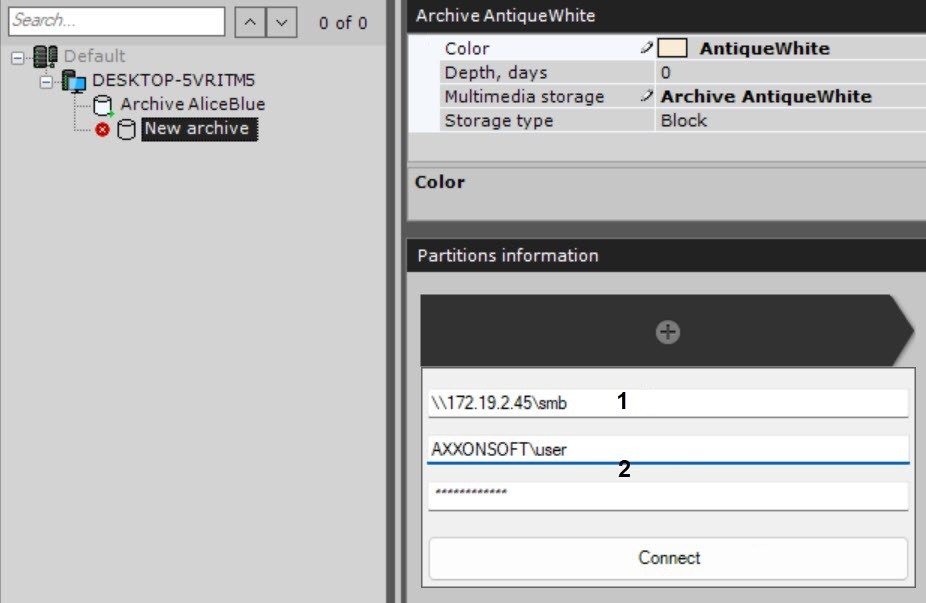
- Specify the name and color of the archive (1). Select the storage type (2):
- In the Color field, select the color of an archive.
- If necessary, in the Depth, days field, specify the maximum depth of storing an archive in days. If you specify the 0 value, the archive depth is unlimited (see Configuring recording to an archive).
- In the Multimedia storage field, specify the name of an archive.
- In the Storage type field, select the type of archive storage:
- Block,
block, - if you need low latency and high performance in various situations. For example, for tasks with a large read and write load;
objectObject, if you need to be able to change the size of
the an archive volume without restarting the system (
see see General information about the Round-robin algorithm), as well as to encrypt
the an archive volume (see Encrypting a volume of an object archive).
Enter a path to the remote storage, where the archive must be located (3).
Note title Attention! If you plan to connect several users from this computer to the remote archive, do the following:
- To the C:\Windows\System32\Drivers\etc\hosts file add the following string: "192.168.1.1 DNSname1", where 192.168.1.1 is the IP address of the remote storage, DNSname1 is the domain name of the remote storage.
- When creating a remote archive, use the specified domain name in the address.
If you need to add several remote archives using different remote user accounts, do the following:
- To the C:\Windows\System32\Drivers\etc\hosts file add the IP addresses and domain names of all remote storages.
- When creating archives, use the specified domain names in the address.
In a failover system with a backup Server (see Setting up a configuration with the backup Server), the hosts file on the backup Server must include records from all Servers, if domain names differ on each Server.
Enter the username and password (4). The user must have permissions to access the remote storage. - In the Partitions information section, click the + button.
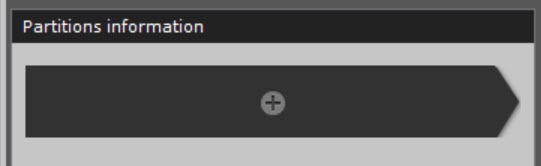
As a result, a panel for configuring a path to a remote storage opens. Enter a path to a remote storage, where an archive must be located (1).
- Enter the username of the user who has permission to access the remote storage (2).
Note title Attention! The username must be specified You must enter the username with a prefix of the domain (domainname\username) or name of the computer (computername\username) where this account is located.
- Enter the password of the user who has access to the remote storage (2).
- Click the
- the Connect button (5)
- .
- This will connect you to the remote storage. When you are connected, you see a dialog box
- window for configuring the archive parameters.
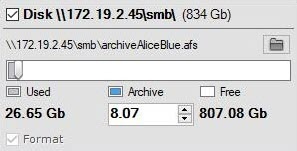
- In the Archive field, enter the file size in GB or set it by moving the slider. The size of the
- an archive file must be greater than or equal to 1 GB. For the Fat32 file system, the maximum archive size is 4 GB.
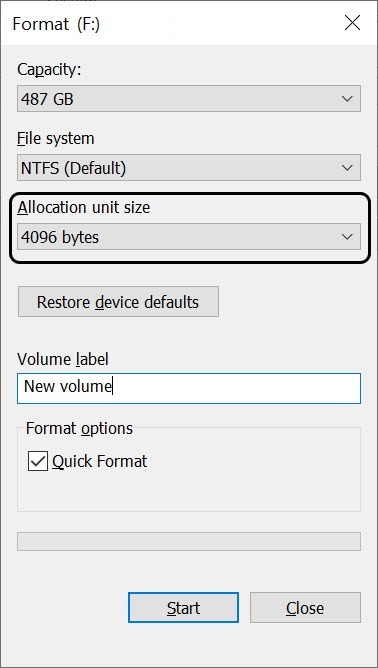
Note title Attention! If you need to create an archive file larger than 16 TB, the cluster size for the NTFS file system must be set to a value greater than 4 KB when formatting the disk in Windows OS. To do this, right-click the disk to which the archive file will be written, and in the menu that opens, select the Format... item.

In the Format window that opens, from the Allocation unit size list, select a cluster size greater than 4 KB and click the Start button.
Info title Note To change the archive folder in the remote storage, click the
 button and select the required location.
- If necessary, you can add other remote storages to the archive and configure their parameters.
- Click the Apply
 button.
| Note | ||
|---|---|---|
| ||
Only one remote user can connect to the remote storage at a time. This is a limitation of Windows OS. If this error occurs, disconnect the previous user in one of the following ways: 1. Run the net use /delete command. 2. Use PsExec to open the command prompt as the LocalSystem user (psexec.exe -i -s cmd.exe) and run the same command. |
Enter the 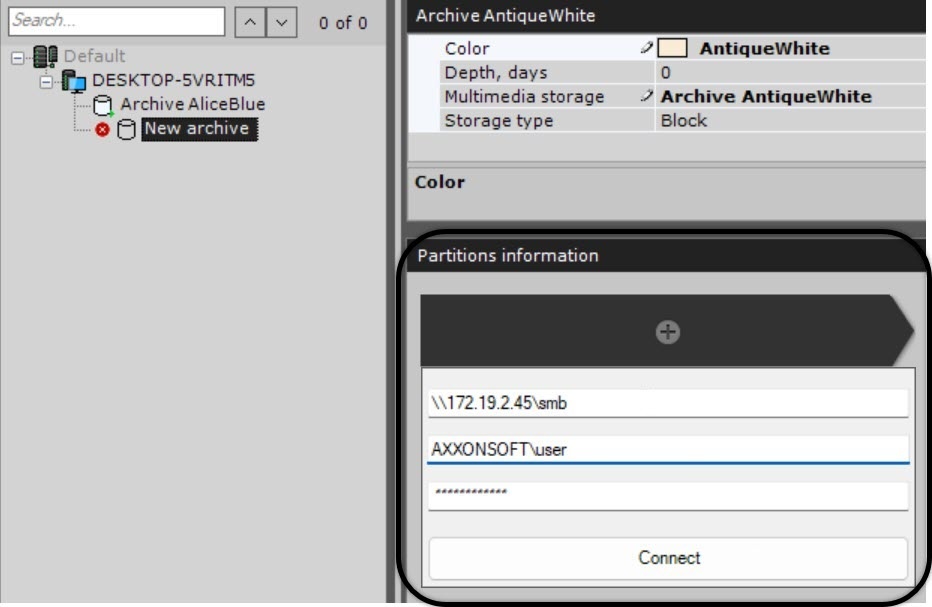 button
 Creating Creation of a remote archive is complete. After the archive is created, the status of the remote storages, where the archive is located, is displayed.

Limitations when working in Windows OS
! Only one remote user can connect to the remote storage at a time.  This is a limitation of Windows OS !
Attempting to connect multiple users at the same time can result in connection errors and storage malfunctions. You can check the active user connections in the Partitions information section.
If this error occurs, disconnect the previous user from the device on which Axxon One is installed in one of the following ways:
- Run the net use /delete command.
- Use the PsExec system program to open the command prompt as the LocalSystem user (psexec.exe -i -s cmd.exe) and run the same command.
| Note | ||
|---|---|---|
| ||
If you plan to connect several users from this computer to a remote archive, do the following:
If you need to add several remote archives using different remote user accounts, do the following:
In a failover system with a backup server (see Setting up a configuration with the backup Server), the hosts file on the backup server must include recordings from all servers if domain names differ on each server. |
Overview
Content Tools