
Go to documentation repository


Configuration parameters of the Axxon PSIM Server and Remote Administrator Workstation are stored in the distributed database. Each Server and Remote Administrator Workstation store local copies of the distributed database. Local database copies must be synchronized to provide the distributed operation of Axxon PSIM software and data replication (synchro alteration of local database copies).
The following synchronization mechanisms are used in Axxon PSIM:
- Internal synchronization. All changes are applied to computers automatically. This mechanism is used by default and doesn't require any further configuration. Internal synchronization can be disabled, see Configuring internal synchronization.
- DB synchronization of recipients with sources when you start Axxon PSIM:
- Configuration synchronization.
Configuration and protocol synchronization with changes to the sync.xml file.
Note
DB tables that aren't synchronized during synchronization are in the sync.xml file. We highly recommend not changing this file.- Only protocol synchronization.
In the simplest case, database synchronization is performed for all Servers and Remote Administrator Workstation with the database of the administering server.

Note
The Remote Client has no database; therefore, the administering server database must not be synchronized with it.
If any selected subnetworks are present in the system, the Server and Remote Administrator Workstation databases must be synchronized with the Server or Remote Administrator Workstation database node (see, for example, the figure below).
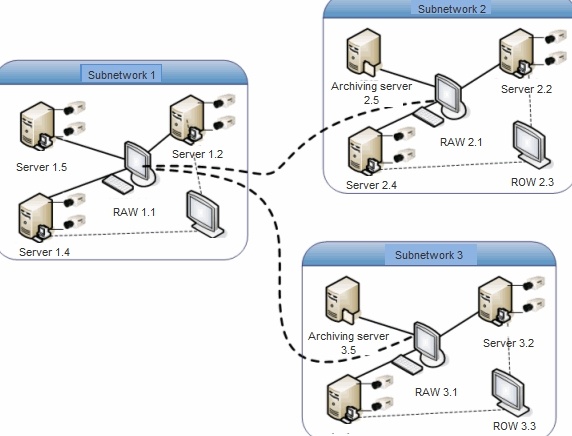
For example, to set up database synchronization for the servers of the distributed system shown in the figure, you must:
- Synchronize the 1.2, 1.4, 1.5 Server databases with the 1.1 Remote Administrator Workstation database;
- Synchronize the 2.2, 2.4 Server databases and an archiving server of 2.5 with the 2.1 Remote Administrator Workstation database;
- Synchronize the 3.2, 3.4 Server databases and an archiving server of 3.5 with the 3.1 Remote Administrator Workstation database;
- Synchronize the 3.1 and 2.1 Remote Administrator Workstation databases with the 1.1 Remote Administrator Workstation database.
Overview
Content Tools