
Go to documentation repository
Previous page Next page
WEB Report System PSIM is installed as an extension to Axxon PSIM. For the information on the compatibility of WEB Report System PSIM with Axxon PSIM versions, see General information about product releases and versions compatibility.
Attention!
WEB Report System PSIM must be installed only on Server/Administrator's workplace (for details, see Axxon PSIM software. Administrator's Guide).
To install WEB Report System PSIM, do the following:


Select MS SQL Server and set the connection parameters (for details, see Installation of Axxon PSIM as a Server/Remote Administrator's workstation).
To continue the installation process, click the Next button.
Note
The WEB Report System PSIM database is created on the selected SQL server.
Later, you can move the database of WEB Report System PSIM to another SQL server.
After that, it is necessary to make changes to the <Axxon PSIM installation directory>\Modules\Wt2\Web.config file by correcting the connection string ReportSystemConnectionString:
<add name="ReportSystemConnectionString" connectionString="Integrated Security=SSPI;Persist Security Info=False;Initial Catalog=ReportSystem;Data Source=(local)\SQLEXPRESS2014;" providerName="System.Data.SqlClient"/>

Specify the connection strings to the main Axxon PSIM database and the POS PSIM receipt database. The connected databases serve as a data source when you create reports.

To set the connection string to the main Axxon PSIM database, do the following:
Click the Connection to the main PSIM DB button.
As a result, the Data Link Properties window opens.

Click the Next button.
The Connection tab opens automatically.
In the 1. Select or enter a server name section, select from the drop-down list or enter manually the name of the SQL server where the main Axxon PSIM database is stored.
To log on to the SQL server, enter authentication parameters.
For this, in the 2. Enter information to log on to the server section, select Use a specific user name and password.
In the User name and Password fields, enter the username (login) and password in order to connect to the SQL server.
Set the Allow saving password checkbox.
To check the connection to the SQL server, click the Test Connection button.
In case the connection is successful, the window with the Test connection succeeded message will be displayed. Click the OK button to close the window.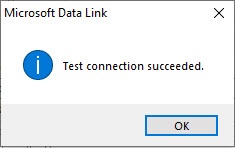
If the name of the SQL server and/or authentication parameters that are used in order to connect to it were set wrong, then the corresponding message is displayed.
Click the OK button to close the window. Then correct the data and check the connection to the SQL server once again.
If the check of the connection to the SQL server is successful, select from the Select the database on the server drop-down list the name of the connected database.
Click the OK button in the Data Link Properties window. As a result, the window closes.
The setup of the connection string to the main Axxon PSIM database is completed.
In the same way, set the connection string to the License Plate Recognizer database (the default database name is lprex).
In the same way, set the connection string to the DetectorPack PSIM database (the default database name is detectorpack).
Note
If you install POS PSIM, Auto PSIM, and DetectorPack PSIM after the WEB Report System PSIM, it is necessary to connect the WEB Report System PSIM database to the corresponding modules. To do this, start the repairing mode of the report system and specify the corresponding connection strings (see Repair).
You can also set the connection strings to all databases through the <Axxon PSIM installation directory>\Modules\Wt2\Web.config file. Examples of connection strings are given below:


The installation of WEB Report System PSIM is completed.

